.png)
-p-130x130q80.png)
Modern supply chains are becoming increasingly complex. Businesses must manage inventory, coordinate shipping, maintain warehouses, and meet growing customer expectations for fast delivery.
This is why many companies turn to third-party logistics providers (3PLs).
A 3PL provider allows businesses to outsource logistics operations such as warehousing, fulfillment, transportation, and inventory management to specialized logistics experts.
In this guide, you’ll learn:
Whether you’re a growing ecommerce brand, manufacturer, or enterprise company, understanding 3PL logistics can help you scale faster and operate more efficiently.
3PL, or third-party logistics, refers to outsourcing logistics services such as warehousing, fulfillment, transportation, and inventory management to an external logistics provider.
Companies partner with 3PL providers to manage supply chain operations without needing to operate their own warehouses, transportation fleets, or fulfillment centers.
Instead of handling logistics internally, businesses rely on specialized logistics partners to manage operations like:
This approach allows companies to focus on core activities like product development, marketing, and sales while logistics experts manage the supply chain.
The term 3PL stands for third-party logistics, referring to a logistics provider that manages supply chain operations for another company. The concept comes from the three parties involved in a transaction:
This outsourcing model has become essential for companies looking to scale distribution efficiently.
According to industry data, the global third-party logistics (3PL) market was valued at about $1.1 trillion in 2022 and is projected to exceed $2.3 trillion by 2031.
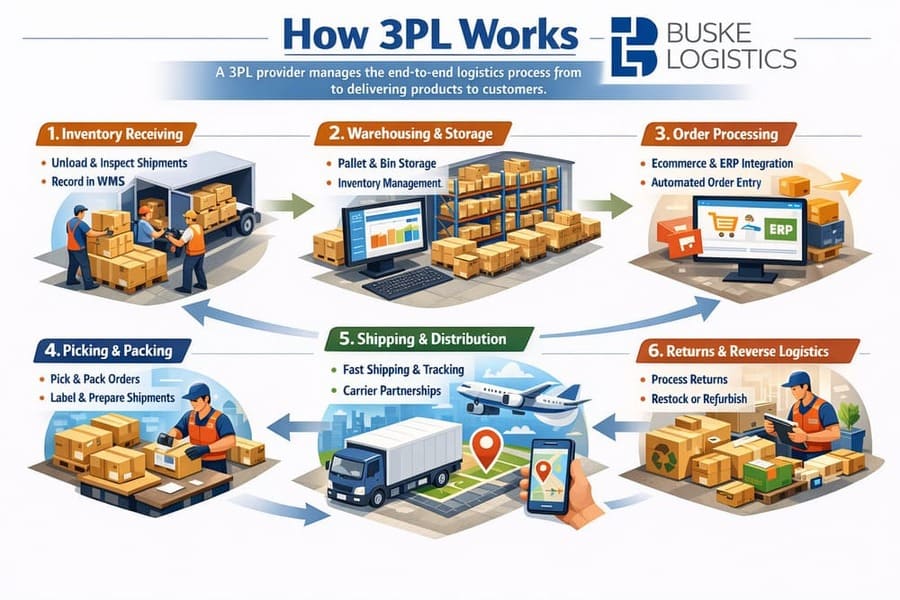
A 3PL provider manages the end-to-end logistics process, from receiving inventory to delivering products to customers. Below is the typical workflow used by most third-party logistics companies.
Products are delivered from manufacturers or suppliers to a 3PL warehouse, where they are checked and prepared for storage. This step ensures inventory accuracy by confirming quantities, inspecting product condition, and recording the items in the warehouse management system before they become available for order fulfillment.
During receiving, the logistics provider:
Once inventory is received, it is organized and stored in the 3PL’s warehouse or distribution center to ensure products are easily accessible for future orders. Modern warehouses use technology such as warehouse management systems (WMS) to track inventory locations, monitor quantities, and maintain accurate stock levels in real time.
Storage options typically include:
When a customer places an order through an e-commerce store, retail system, or B2B ordering platform, the order details are automatically transmitted to the 3PL provider. This integration allows orders to quickly enter the fulfillment workflow, reducing manual work and ensuring faster, more accurate processing.
Integrations connect the 3PL with systems such as:
Once an order is processed, warehouse staff locate the required items within the facility and prepare them for shipment. Many 3PL providers also offer value-added services such as custom packaging, kitting, and product assembly to meet specific brand or order requirements.
This step includes:
Once packaged, orders are shipped to the final destination through established transportation and delivery networks. 3PL providers coordinate with multiple shipping carriers and freight companies to streamline distribution and ensure timely deliveries.
3PL providers often manage relationships with shipping carriers and freight companies, allowing them to:
Many third-party logistics providers also handle product returns as part of their fulfillment services. Efficient returns management helps maintain customer satisfaction while ensuring returned products are properly inspected, processed, and either restocked or redirected.
Reverse logistics services include:
Most 3PL companies offer a comprehensive range of logistics services designed to support complex supply chains. When you partner with a 3PL provider, you gain access to specialized systems, infrastructure, and logistics expertise that help your business operate more efficiently as it grows.
Warehousing is one of the most fundamental services offered by third-party logistics providers. Instead of investing in your own storage facilities, you can leverage professionally managed warehouses that keep your products organized, secure, and ready for distribution.
Warehousing services may include:
These services allow you to store products closer to your customers while reducing the overhead costs and operational complexity of managing your own warehouse network.
Order fulfillment involves preparing and shipping customer orders quickly and accurately. With a 3PL partner managing fulfillment operations, you can focus on growing your business while ensuring every order is processed efficiently.
Fulfillment services typically include:
Many ecommerce businesses rely on 3PL providers to handle fulfillment at scale, helping you deliver orders faster and maintain a consistent customer experience even during peak demand periods.
Transportation management services help you move products efficiently across your supply chain. A 3PL partner coordinates shipments, manages carrier relationships, and optimizes delivery routes to keep your logistics costs under control.
This includes:
Transportation management systems (TMS) are often used to streamline shipping operations, giving you better visibility into shipments while improving delivery speed and reliability.
Inventory management services ensure accurate tracking of your products across warehouses and distribution centers. With real-time visibility into stock levels, you can make better decisions about purchasing, replenishment, and demand planning.
These services may include:
Accurate inventory management helps you prevent stockouts and overstocking, allowing your business to maintain healthy inventory levels while meeting customer demand consistently.
Reverse logistics focuses on managing product returns and product recovery in an organized and cost-effective way. Instead of handling complex return processes internally, you can rely on a 3PL provider to manage returns efficiently.
Services may include:
Efficient reverse logistics helps you reduce waste, recover value from returned products, and maintain a positive customer experience when handling returns or exchanges.
Outsourcing your logistics operations can unlock several strategic advantages for your business. When you partner with a 3PL provider, you gain access to infrastructure, technology, and logistics expertise that would otherwise require significant time and investment to build internally.
Operating warehouses and transportation networks requires significant investment in facilities, staff, technology, and equipment. By working with a 3PL provider, you can reduce these expenses and benefit from a more cost-efficient logistics structure.
3PL providers achieve cost savings through:
These efficiencies often reduce your overall logistics costs while allowing you to operate with a more flexible and scalable supply chain.
Many 3PL providers operate multiple distribution centers across different regions. This allows you to store inventory closer to your customers and reduce the distance orders must travel.
As a result, your business can offer faster delivery times, improve customer satisfaction, and remain competitive in markets where speed and reliability are critical.
3PL services allow your business to scale operations quickly as demand increases. Instead of investing in new warehouses or expanding internal logistics teams, you can leverage an existing network designed for growth.
This flexibility makes it easier for you to handle seasonal spikes, new product launches, or market expansion without disrupting your operations.
Third-party logistics providers specialize in managing complex supply chain operations. When you work with a 3PL partner, you gain access to professionals who understand logistics strategy, systems, and operational best practices.
They bring expertise in:
This expertise helps you avoid costly mistakes, improve operational efficiency, and maintain compliance with industry regulations.
Managing logistics internally can consume significant time and resources that could be better spent growing your business. By outsourcing these responsibilities, you free up your internal teams to focus on higher-value activities.
This allows you to prioritize product development, marketing initiatives, and customer acquisition while your 3PL partner ensures your supply chain runs smoothly.
Many companies evaluate 3PL vs 4PL providers when deciding how to outsource logistics. Understanding the distinctions helps you choose the solution that best aligns with your business goals and operational needs.
A 3PL provider handles the day-to-day operational logistics of your business, including warehousing, fulfillment, and shipping. They physically manage your inventory and distribution, allowing you to outsource the hands-on work of moving products to your customers.
A 4PL (fourth-party logistics) provider takes a strategic, end-to-end approach to your supply chain.
Instead of directly handling operations, they oversee multiple logistics partners, integrate systems, and optimize processes to improve efficiency across your entire supply chain.
3PL vs 4PL Logistics Comparison
Most companies begin with 3PL services and adopt 4PL models later as supply chains become more complex.
The cost of partnering with a 3PL provider depends on the range of services you need and the complexity of your supply chain. Pricing structures are designed to be flexible, so you pay for the services that align with your business volume and operational requirements.
Common pricing components include:
Receiving fees cover the costs associated with unloading, inspecting, and processing inbound inventory at a 3PL warehouse. These fees ensure your products are accurately logged and ready for storage or fulfillment without adding strain to your internal team.
Pricing may be based on:
This structure allows you to pay only for the actual handling of your inventory, keeping costs transparent and tied to your operational volume.
Storage fees cover the cost of keeping your inventory safely in a 3PL warehouse. By outsourcing storage, you avoid the expense of owning or managing your own facilities while ensuring your products are organized and accessible.
Pricing models may include:
These flexible options allow you to choose the most efficient and cost-effective method based on your product size, volume, and turnover rate.
Pick and pack fees cover the labor involved in retrieving products from storage and preparing them for shipment. This service ensures each order is accurately assembled and packaged for delivery, saving you time and reducing errors.
Pricing typically includes:
This structure allows you to scale fulfillment costs with order size, so you only pay for the labor required to complete each shipment.
Shipping costs cover the expense of transporting your products from the warehouse to your customers. Partnering with a 3PL gives you access to negotiated carrier rates and optimized shipping options to help reduce delivery costs.
Shipping costs depend on:
By leveraging a 3PL’s network, you can offer faster and more reliable shipping while controlling expenses.
Some 3PL providers charge additional fees for integrating your systems with their warehouse management or order fulfillment platforms. These fees also cover access to advanced reporting tools, dashboards, and analytics that give you real-time visibility into your inventory and shipments.
Investing in these services helps streamline operations, improve accuracy, and provide actionable insights for smarter supply chain decisions.
Tip: Always ask for a detailed breakdown and check for hidden charges or volume minimums.
How much does a 3PL cost? Expect anywhere from $2–$5 per order plus storage and shipping, depending on product type and order volume.
Check out our 3PL Pricing and Fulfillment Cost Guide for more comprehensive details.
Third-party logistics providers support companies across a wide range of industries, helping businesses streamline operations and scale efficiently. No matter the sector, 3PL partners bring expertise, infrastructure, and technology to manage complex supply chains.
Ecommerce
Ecommerce businesses often rely on 3PL providers to handle order fulfillment, shipping, and returns. This allows online retailers to focus on growing their brand while ensuring fast and accurate delivery to customers.
Manufacturing
Manufacturers use 3PL providers to manage the storage and movement of raw materials, components, and finished goods. By outsourcing these logistics tasks, manufacturers can optimize production schedules and distribution without investing in extensive infrastructure.
Retail
Retail companies depend on logistics partners to distribute products efficiently to stores and end customers. 3PL providers help retailers maintain stock levels, manage seasonal demand, and expand to new markets without operational bottlenecks.
Food and Beverage
Food and beverage distribution requires specialized logistics capabilities, including temperature-controlled storage and compliance with food safety regulations. 3PL providers ensure products are stored, handled, and delivered safely while meeting all regulatory standards.
Healthcare and Pharmaceuticals
Healthcare logistics demands strict regulatory compliance, secure handling, and specialized storage solutions for sensitive products. Partnering with a 3PL helps healthcare and pharmaceutical companies maintain product integrity and timely delivery while reducing operational complexity.
Choosing the right 3PL logistics partner is a critical decision that can impact your supply chain efficiency and customer satisfaction. By carefully evaluating potential providers, you can find a partner that aligns with your business goals, volume requirements, and operational complexity.
Key factors to consider include:
Pro tip: When doing vendor evaluations, ask each 3PL company to solve a small-scale scenario relevant to your business (e.g. “How would you handle a 25% spike in volume?”). Compare their answers, not just the price.
By applying this framework, you can filter and compare 3PL companies and land on a partner that truly aligns with your growth goals and operational needs.
The logistics industry is undergoing a major transformation as supply chains become more technology-driven, customer-centric, and sustainability-focused. Third-party logistics (3PL) providers are no longer just warehousing and shipping partners; they are strategic allies that help businesses optimize operations, reduce costs, and scale efficiently in an increasingly competitive market.
Key trends shaping the future of 3PL include:
With ecommerce continuing its rapid growth and supply chains becoming increasingly digitized, the global 3PL market is projected to reach nearly $1.9 trillion by 2030. Businesses that partner with forward-thinking 3PL providers can leverage cutting-edge technology, gain a competitive edge, and meet the demands of modern consumers faster and more efficiently than ever before.
3PL stands for third-party logistics, a business model where companies outsource logistics functions such as warehousing, order fulfillment, transportation, inventory management, and distribution to a specialized provider. By partnering with a 3PL, businesses can improve supply chain efficiency, reduce operational costs, and focus on core business activities instead of managing complex logistics operations internally. Third-party logistics providers offer the expertise, infrastructure, and technology needed to support growth and improve service levels. This makes 3PL an essential solution for businesses looking to scale efficiently.
3PL companies provide a comprehensive range of logistics services including warehousing, inventory management, order fulfillment, transportation management, freight coordination, returns processing, and value-added services such as kitting and packaging. These solutions help businesses streamline supply chain operations while improving inventory visibility and delivery performance. Many 3PL providers also offer advanced technology platforms that provide real-time reporting and tracking capabilities. By consolidating logistics functions under one provider, businesses can improve efficiency and customer satisfaction.
Fulfillment is one component of 3PL services and focuses primarily on receiving, storing, picking, packing, and shipping customer orders. Third-party logistics encompasses fulfillment but also includes broader supply chain services such as transportation management, inventory optimization, freight brokerage, warehousing strategy, and logistics consulting. While fulfillment centers concentrate on processing orders, a 3PL provider manages multiple aspects of the supply chain to improve overall performance. This broader scope allows businesses to create more efficient and scalable logistics operations.
Companies use 3PL providers to reduce logistics costs, improve operational efficiency, and gain access to specialized expertise without investing in their own warehouse network or transportation infrastructure. Outsourcing logistics allows businesses to scale more easily, adapt to changing demand, and improve customer service through faster and more reliable fulfillment. Many 3PLs also provide advanced technology, analytics, and supply chain visibility that would be costly to implement independently. These advantages help businesses remain competitive while focusing on growth initiatives.
A 3PL improves e-commerce shipping by streamlining inventory management, automating fulfillment processes, and leveraging carrier relationships to optimize shipping costs and transit times. Through integrated technology platforms, businesses gain real-time visibility into inventory levels, order status, and shipment tracking. Faster order processing and strategically located warehouses help reduce delivery times and improve the customer experience. This enables e-commerce brands to scale efficiently while maintaining high fulfillment accuracy and service quality.
Yes, many 3PL providers support international shipping through services such as freight forwarding, customs documentation, import and export coordination, cross-border transportation, and regulatory compliance management. Their expertise helps businesses navigate complex international logistics requirements while minimizing delays and reducing compliance risks. Global logistics support also improves visibility and coordination across international supply chains. As a result, businesses can expand into new markets with greater confidence and operational efficiency.
When selecting a 3PL provider, businesses should evaluate factors such as industry experience, service offerings, technology capabilities, warehouse network, geographic coverage, scalability, customer support, and pricing structure. It's also important to assess the provider’s ability to integrate with existing systems and support future growth plans. A strong 3PL partner should offer transparency, reliability, and customized solutions that align with your operational goals. Choosing the right provider can significantly improve supply chain performance, customer satisfaction, and long-term business success.
Buske Logistics is a trusted third-party logistics provider offering scalable warehousing, fulfillment, and transportation solutions across the United States. Trusted by leading brands such as Diageo, PepsiCo, Ardagh, Stellantis, Ford, Morgan Foods, and Starbucks, Buske combines advanced technology, nationwide facilities, and 100+ years of experience to help businesses reduce risk, control costs, and build more resilient supply chains.
Next Step: Explore Buske’s 3PL services or speak with our 3PL expert to see how the right third-party logistics partner can transform your supply chain.

Buske Logistics is a Top 20 Private Warehousing 3PL. Let's build a solution for your supply chain.


