.png)
-p-130x130q80.png)

Pallet picking in a warehouse is a fulfillment method where an entire pallet of a single SKU is retrieved and shipped without being broken down into individual cases or pieces. If your business regularly fulfills high-volume orders for retailers, distributors, or manufacturers, pallet picking can improve warehouse efficiency, reduce handling, and lower labor costs.
Unlike case picking or piece picking, pallet picking moves the largest unit in the warehouse picking hierarchy. Instead of selecting individual cases or products, operators retrieve a complete unit load using material handling equipment and transport it directly to staging or outbound shipping.
At Buske Logistics, our warehousing solutions help businesses optimize warehouse operations through efficient picking strategies, inventory management, and distribution.This guide explains how pallet picking works, when to use it, and how it compares to other warehouse picking methods.
Pallet picking is a warehouse fulfillment method in which an entire pallet is picked and shipped as a single unit load. Instead of removing individual cases or products, warehouse associates retrieve the complete pallet to fulfill an order.
Within the warehouse picking hierarchy, pallet picking represents the largest picking unit, followed by case picking and piece picking. It is commonly used for full-pallet, single-SKU orders destined for retailers, distributors, manufacturers, or distribution centers that replenish inventory in bulk.
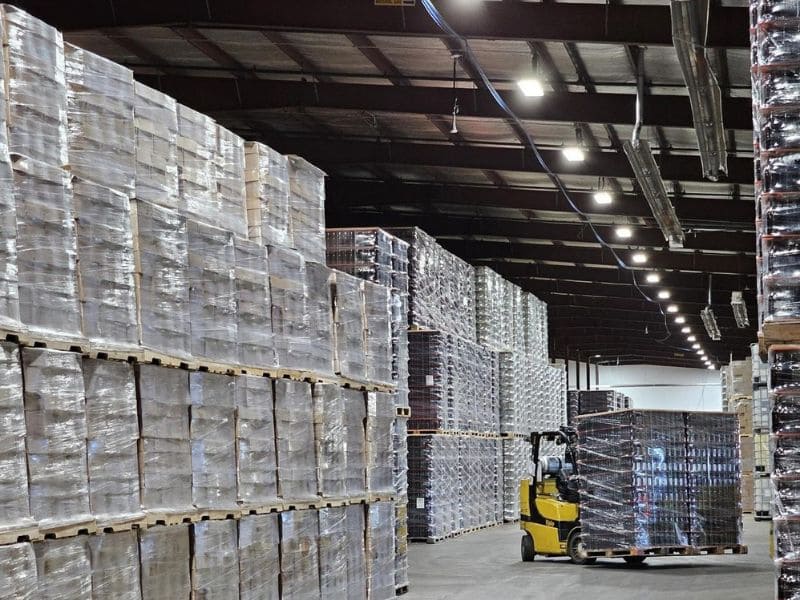
In a warehouse, pallet picking involves retrieving a complete pallet from bulk or reserve storage and transporting it directly to a staging area or outbound trailer. Operators typically use forklifts, reach trucks, pallet jacks, or automated guided vehicles (AGVs), depending on the warehouse layout and storage system. OSHA classifies forklifts as powered industrial trucks and provides guidance on their safe operation in warehouse environments.
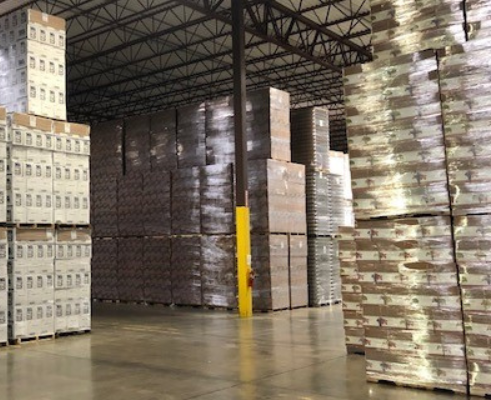
Pallets are commonly stored in bulk floor locations, selective racking, drive-in racking, or high-density reserve storage. Because the entire pallet is moved without being broken down, pallet picking minimizes product handling while supporting fast, efficient fulfillment for pallet-quantity orders.
This picking method is most common for businesses shipping full-pallet quantities to large retailers, wholesalers, distributors, manufacturers, and regional distribution centers that require bulk inventory replenishment.
Pallet picking follows a straightforward workflow that minimizes handling and speeds up fulfillment. Consider a beverage distributor receiving an order for ten full pallets of bottled water from a national retail chain.
Because products remain on the original pallet throughout the process, pallet picking reduces touches, improves accuracy, and speeds up order fulfillment.
While all three methods are used to fulfill warehouse orders, the appropriate picking strategy depends on order size, SKU mix, and customer requirements.
Pallet Picking is ideal when customers order full pallets of a single SKU. It is the fastest picking method because products remain on the original pallet from storage through shipping.
Case Picking involves selecting individual cases from a pallet. It provides greater flexibility for customers that need multiple cases without requiring a full pallet.
Piece Picking is the most granular picking method, where individual items are selected to fulfill an order. It is commonly used for ecommerce, retail replenishment, and orders containing multiple SKUs.
Many warehouses use a hybrid picking strategy that combines pallet, case, and piece picking based on customer order profiles. Understanding how these methods work together helps businesses choose the most efficient fulfillment process for different order types.
Pallet picking is one of the most efficient warehouse picking methods for high-volume fulfillment. Because an entire unit load is moved at once, it minimizes product handling, improves productivity, and simplifies the flow of inventory from storage to shipping.
Pallet picking requires fewer handling steps than case or piece picking because the entire pallet is retrieved and shipped as a single unit. This allows warehouse teams to fulfill large orders more quickly while increasing throughput.
Moving one pallet instead of multiple cases or individual products reduces manual handling and labor hours. As a result, pallet picking typically has the lowest labor cost per unit shipped when fulfilling full-pallet orders.
Each time inventory is handled, the risk of product damage increases. Since pallet picking keeps products on the original pallet throughout the fulfillment process, it minimizes handling, helping reduce damage, shrinkage, and picking errors.
Pallet picking creates a direct flow from reserve storage to outbound shipping. By eliminating unnecessary breakdown and repacking, warehouses can simplify operations, improve productivity while supporting more efficient inventory management throughout the warehouse.
Although pallet picking is highly efficient for bulk orders, it is not the right solution for every operation. Before implementing this picking method, you should consider the space, equipment, and inventory requirements needed to support full-pallet fulfillment.
Pallet picking relies on bulk and reserve storage, which requires larger storage areas and wider aisles for forklifts and other material handling equipment. Warehouse layouts must be designed to safely accommodate full-pallet movement.
Because products are shipped as complete pallets, pallet picking cannot efficiently fulfill mixed-SKU, partial-pallet, or ecommerce orders. Warehouses serving a wide variety of order sizes often combine pallet, case, and piece picking to meet customer demand.
Pallet picking depends on forklifts, reach trucks, pallet jacks, or automated equipment to retrieve inventory safely. Operators must be properly trained to minimize product damage, maintain productivity, and ensure workplace safety.
Businesses using pallet picking often maintain larger quantities of inventory to support full-pallet orders. If demand is unpredictable or products move slowly, carrying excess inventory can increase storage costs and tie up working capital.
Pallet picking is most effective when customers consistently order full-pallet quantities of a single SKU. It works especially well for high-volume products with predictable demand, allowing warehouses to move inventory quickly while minimizing labor and handling costs.
You should consider pallet picking if your operation regularly fulfills orders for retailers, distributors, manufacturers, or regional distribution centers that replenish inventory in bulk. High-velocity SKUs and standardized pallet configurations are ideal for this picking method.
However, most warehouses don't rely on pallet picking alone. A hybrid picking strategy that combines pallet, case, and piece picking allows businesses to efficiently fulfill bulk shipments, mixed-case orders, and individual ecommerce purchases while maximizing warehouse productivity.
You can maximize the efficiency of pallet picking by optimizing warehouse layout, reducing travel time, and using data to improve operational performance.
Following these best practices helps improve throughput, increase picking accuracy, reduce labor costs, and create a safer, more efficient warehouse operation.
Pallet picking is a warehouse fulfillment method where an entire pallet—a full unit load of a single SKU—is picked and shipped without being broken down into individual cases or pieces. It's commonly used for high-volume orders placed by retailers, distributors, and manufacturers.
In a warehouse, pallet picking involves retrieving a complete pallet from bulk or reserve storage using equipment such as a forklift, reach truck, pallet jack, or automated guided vehicle (AGV). The pallet is then moved directly to a staging area or outbound trailer for shipment.
Pallet picking moves an entire pallet as one unit, while case picking involves selecting individual cases from within a pallet. Pallet picking is best for full-pallet orders, whereas case picking is used when customers need multiple cases but not a complete pallet.
Common equipment includes forklifts, reach trucks, pallet jacks, and, in automated facilities, automated guided vehicles (AGVs) or automated storage and retrieval systems (AS/RS). The right equipment depends on your warehouse layout, storage configuration, and order volume.
Pallet picking is most effective when orders consistently require full-pallet quantities of a single SKU. If your customers frequently order mixed SKUs or partial quantities, case picking or piece picking is generally the better choice.
The primary challenges include the need for bulk storage space, reliance on material handling equipment and trained operators, and limited flexibility for mixed-SKU or low-volume orders. Warehouses often address these limitations by combining pallet, case, and piece picking within the same operation.
Pallet picking is the most efficient warehouse picking method for moving full-pallet quantities with minimal handling, making it ideal for high-volume distribution and replenishment. However, the best fulfillment strategy depends on your order profiles, inventory characteristics, and customer requirements.
Many operations combine pallet, case, and piece picking to balance speed, flexibility, and efficiency. Understanding when to use each method can help you optimize warehouse performance, reduce labor costs, and improve order accuracy.
See how pallet picking fits into your broader warehouse picking strategy by exploring our guide to Case Picking in a Warehouse or contact Buske Logistics to learn how our contract warehousing and fulfillment solutions can support your operation.

Buske Logistics is a Top 20 Private Warehousing 3PL. Let's build a solution for your supply chain.