.png)
-p-130x130q80.png)
Retail compliance means meeting the specific operational, labeling, packaging, and shipping standards that major retailers require from their suppliers. When you get it right, your products move faster, chargebacks disappear, and your retail partnerships stay strong.
If you have ever received a chargeback from Walmart, Target, or Kroger, you already know the pain. One missed label, one wrong pallet configuration, or one late delivery can trigger a fee that wipes out your margin on an entire order.
According to industry data, supplier chargebacks in retail can range from $100 to several thousand dollars per incident, and repeat offenders risk being deprioritized or dropped from retailer programs altogether.
The stakes are real. Major retailers enforce compliance programs to protect their own supply chain efficiency.
When a pallet arrives without the correct GS1 barcode labeling or with the wrong case count, it creates downstream problems for the retailer's receiving team, inventory system, and shelf replenishment cycle. The cost of that disruption gets passed back to the supplier through retail compliance penalties.
For growing brands trying to break into big-box retail or direct-to-consumer channels, compliance errors are especially damaging. They signal operational immaturity at exactly the wrong moment. That is why so many mid-market brands and Fortune 500 suppliers turn to a trusted third-party logistics partner to manage this on their behalf.
Retail compliance requirements are not one-size-fits-all. Every major retailer publishes its own vendor compliance manual, and those manuals can run dozens of pages. That said, most programs share a core set of requirements that suppliers need to master.
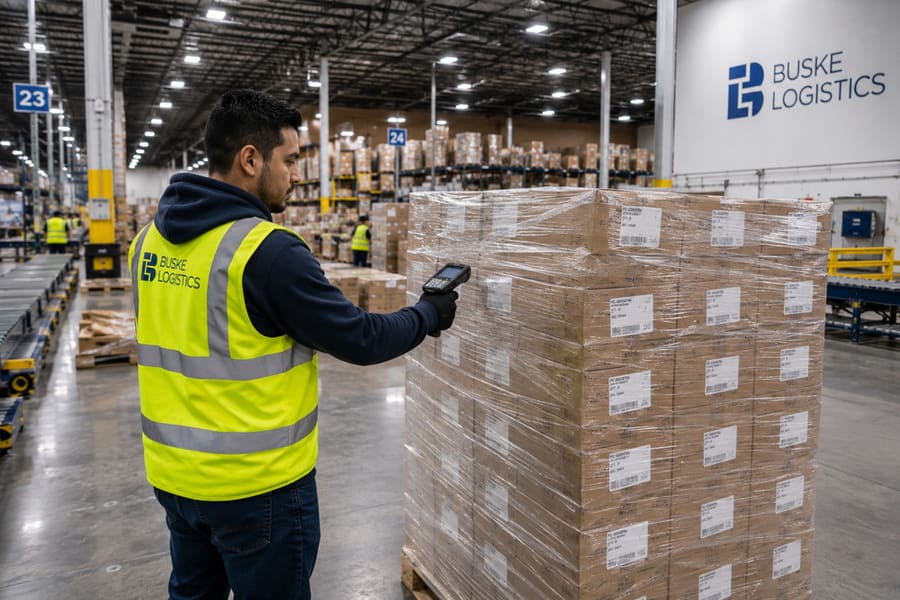
Retailers require specific label formats, placement, and information. This typically includes:
Errors here are caught at the dock door, and the chargeback follows within days.
Most major retailers require EDI-compliant transactions for purchase orders, advance ship notices (ASNs), and invoices. The EDI standards published by GS1 US define how data must be structured, and any deviation can cause an ASN rejection, which triggers its own penalty.
Many retailers dictate which carriers you must use, when appointments must be scheduled, and how freight should be tendered. Failing to follow a retailer's routing guide, even if your shipment arrives on time, can result in a routing violation charge.
Walmart's OTIF program is one of the most well-known enforcement mechanisms in the industry. Suppliers are expected to deliver the right quantity, to the right location, within a tight delivery window.
Walmart's supplier requirements outline detailed expectations for shipping, packaging, labeling, palletization, and supply chain compliance.
For apparel and certain consumer goods, retailers require products to arrive floor-ready, meaning pre-ticketed, pre-hung, and ready to place on the sales floor without any additional handling at the store level.
Getting retail compliance right is not just about avoiding penalties. It is a genuine competitive advantage. Here is what consistent compliance performance delivers:
Brands like PepsiCo and Molson Coors operate at the scale where compliance is embedded in every step of their supply chain. Smaller brands that want to compete at that level need the same infrastructure, which is why partnering with a 3PL that specializes in this space makes so much sense.
Getting compliant is one challenge. Staying compliant as your business scales is another. These are the practices that separate high-performing suppliers from chronic offenders.
Retailer compliance manuals change. Walmart, Target, and Costco update their routing guides and labeling requirements periodically, and most send notifications only through their supplier portals. Assign someone on your team to review these updates quarterly and flag changes that affect your operations.
A modern warehouse management system is the operational backbone of compliance. It enforces pick accuracy, label generation, pallet configuration, and ASN creation at the workflow level rather than relying on manual checks.
When your WMS is configured to a retailer's specific requirements, errors become the exception rather than the rule.
Many OTIF failures are not transportation problems. They are inventory problems. If stock is not available when a purchase order drops, nothing else matters.
Good warehouse replenishment processes ensure that inventory is positioned correctly, cycle counts are current, and safety stock levels are maintained for your highest-velocity SKUs.
Before a retailer audits you, audit yourself. Walk through the process from purchase order receipt to shipment, and verify that every step matches the retailer's vendor guide.
Use a compliance checklist that mirrors the retailer's own assessment criteria. Document your findings and track improvement over time.
If managing compliance in-house is stretching your team thin, outsourcing to a qualified 3PL is one of the most effective decisions you can make. A good partner has already mapped out the requirements for dozens of retailers, built the WMS configurations, trained the labor, and absorbed the institutional knowledge that takes years to develop internally.
Buske Logistics has been doing exactly this for over 100 years. With 40+ facilities across the U.S. and Canada, we specialize in helping brands like Golden State Foods and Diageo meet the exacting standards of major retail partners.
Our dedicated retail compliance solutions are built to reduce chargebacks, improve scorecards, and keep your supply chain audit-ready at every level.
Compliance is only as strong as the weakest link in your process. That includes your packaging supplier, your transportation carrier, and every person on the warehouse floor. Regular training on retailer-specific requirements, combined with clear accountability structures, dramatically reduces the frequency of errors.
If your team is spending more time managing chargeback disputes than growing your retail relationships, it is time to rethink your approach. Getting the operational details right requires infrastructure, experience, and a deep understanding of what each retailer actually enforces.
Buske Logistics is the 3PL partner built for exactly this challenge. With over 100 years of logistics expertise and a client roster that includes some of the most demanding Fortune 500 brands in North America, including Starbucks and Mother Parkers, we bring the scale and knowledge to make compliance a strength rather than a liability.
Reach out to our team today to talk through your current compliance challenges, chargeback history, and retailer requirements. We will help you build a supply chain process that keeps you in good standing with every retail partner you serve.
Retail compliance in logistics refers to the process of meeting a retailer's specific operational, labeling, packaging, and shipping requirements as a condition of doing business with them. It covers everything from how pallets are configured to how electronic purchase orders are transmitted and acknowledged. Non-compliance typically results in financial chargebacks and can affect your standing as a preferred supplier.
The most common requirements include GS1 barcode labeling, EDI transaction accuracy, routing guide adherence, OTIF delivery performance, and correct pallet and case configurations. Each major retailer publishes its own vendor compliance manual. Walmart, Target, and Costco each have distinct standards, so suppliers who sell across multiple channels need to manage multiple sets of requirements simultaneously.
Chargebacks are financial penalties that retailers deduct from a supplier's invoice when a shipment or transaction does not meet their compliance standards. They can be triggered by incorrect labeling, late deliveries, wrong quantities, EDI errors, or routing violations. Chargeback amounts vary by retailer and offense type, but they can add up quickly for high-volume suppliers.
Yes, an experienced 3PL that specializes in retailer compliance can significantly reduce chargeback frequency by building retailer-specific requirements into their warehouse and transportation processes. This includes configuring warehouse management systems to enforce correct label generation, pallet building, and ASN creation. Buske Logistics, for example, has deep expertise across the major retail compliance programs and manages these processes on behalf of clients daily.
Retailers use compliance scorecards to track supplier performance across delivery, labeling, EDI accuracy, and fill rates, and these scores directly influence business opportunities like shelf placement and promotional inclusion. High-performing suppliers are rewarded with expanded distribution, while chronic offenders may be deprioritized or removed from retailer programs. Maintaining a strong scorecard is as much a growth strategy as it is a risk management one.
Retail compliance refers to meeting individual retailer operational standards, while retail regulatory compliance refers to meeting government regulations that apply to retail products and supply chains. Regulatory compliance covers areas like the FDA's food labeling requirements and FTC country of origin rules. Both matter for suppliers, but they operate independently and are enforced by different bodies.
Staying compliant across multiple retail channels requires a centralized compliance management process that can track and apply retailer-specific requirements at the SKU and shipment level. Most brands that successfully manage multi-channel retail do so with the help of a WMS that supports retailer-specific configurations and a 3PL partner that has pre-built templates for each major retail program.
Retail compliance is not a back-office function. It is a direct driver of revenue, margin, and retailer relationships. Every dollar saved in chargebacks is a dollar that goes toward growth. Every strong scorecard is an invitation to expand your retail footprint.
If you are ready to stop reacting to chargebacks and start building a supply chain that keeps pace with the demands of modern retail, Buske Logistics is the partner to call.
Explore our full range of supply chain solutions and see how we help brands compete at the highest level.

Buske Logistics is a Top 20 Private Warehousing 3PL. Let's build a solution for your supply chain.