.png)
-p-130x130q80.png)
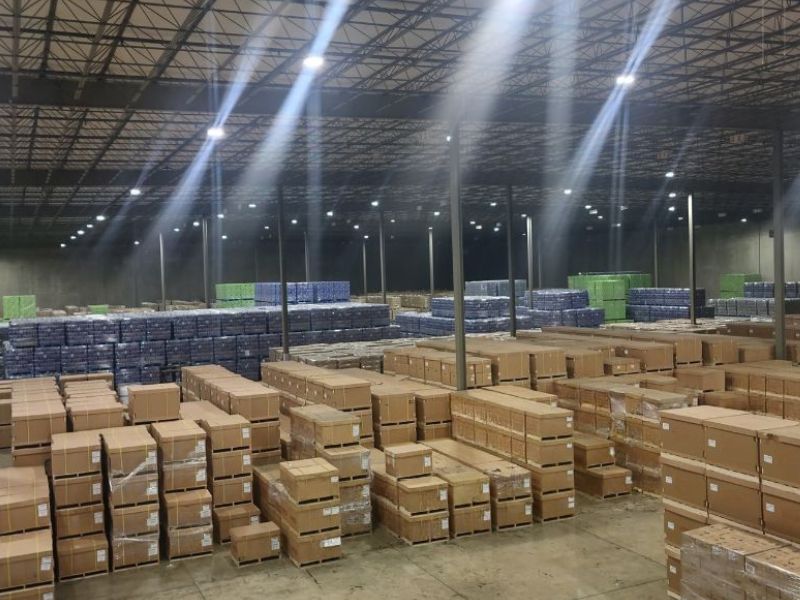
If you are running a business that ships physical products, warehouse distribution is either one of your biggest competitive advantages or one of your biggest operational headaches. There is rarely a middle ground.
For enterprise companies and fast-growing brands, getting distribution right means customers receive their orders on time, inventory is where it needs to be, and your supply chain holds up under pressure. Getting it wrong means late shipments, inventory imbalances, unhappy customers, and margins that erode with every inefficiency.
This guide covers everything you need to know about warehouse distribution; what it is, how it works, the challenges that trip up even well-resourced operations, the technologies transforming the space in 2026, and what to look for in a distribution partner that can actually scale with you.
Warehouse distribution is the end-to-end process of receiving goods into a warehouse facility, storing them, and moving them out to their final destinations. Those destinations could be retail stores, other fulfillment centers, business customers, or consumers receiving direct-to-door deliveries.
It is the operational layer that sits between your supply chain and your customer. Every order you fulfill, every shipment that goes out the door, every return that comes back in, all of it runs through your distribution operation.
Warehouse distribution typically includes:
At Buske Logistics, we manage all of these functions across a strategically placed network of North American facilities, built specifically to serve enterprise accounts and brands that are scaling at pace.
Understanding the flow of a distribution operation helps you spot where yours might be losing time, accuracy, or money.
The process starts when inventory arrives at the facility. Efficient receiving means cross-checking inbound shipments against purchase orders, scanning items into the warehouse management system (WMS), flagging discrepancies, and routing products to storage locations without delay.
Receiving errors such as wrong counts, missed damage, delayed check-ins are among the most common sources of downstream inventory inaccuracy. A disciplined receiving process prevents those problems before they start.
Once inventory is received and logged, it gets placed into storage. Strategic slotting puts high-velocity SKUs in the most accessible locations, reducing the distance pickers travel and cutting the time it takes to fulfill each order.
Slotting is not a set-it-and-forget-it task. Demand patterns shift, new products are introduced, and seasonal spikes change which SKUs need prime real estate. The best distribution operations treat slotting as a continuous process, not a one-time setup.
Picking is where most distribution labor gets spent and where most accuracy problems originate. There are several picking strategies in use across modern distribution centers:
The right strategy depends on your order volume, SKU count, facility layout, and fulfillment speed requirements.
After picking, orders are packed for shipment. This includes selecting the right packaging to protect the product and manage dimensional weight costs, applying shipping labels, inserting any required documentation or branded materials, and running accuracy checks to catch errors before they leave the building.
For enterprise brands, packing is also where brand experience gets created or destroyed. The right 3PL partner builds packing workflows that reflect your brand standards, not just generic fulfillment procedures.
Outbound logistics connects your distribution operation to your carriers. This means rate shopping across your carrier network, generating manifests, scheduling pickups, and ensuring every shipment has accurate documentation. According to the Bureau of Transportation Statistics, freight movement in the U.S. is projected to grow significantly through the decade, meaning the carrier relationships and shipping integrations you build now will carry increasing weight as your volume scales.
Returns are a permanent part of any distribution operation. An efficient returns process quickly checks in returned items, inspects and sorts them by condition, updates inventory records in real time, and routes recoverable product back into sellable stock. Slow or inaccurate returns processing creates inventory gaps and customer service problems that compound over time.
Not all distribution operations are structured the same way. The model you use depends on your product type, customer base, order profile, and geographic reach.
All inventory is held in one or a small number of central facilities. Centralized models are simpler to manage and often more cost-efficient at lower volumes, but they create longer transit times to customers in distant markets which increasingly matters as two-day delivery becomes the baseline expectation.
Inventory is spread across multiple regional facilities positioned close to key customer populations. This reduces transit times and shipping costs but requires more sophisticated inventory management to keep stock balanced across locations. For enterprise brands with national or North American reach, a distributed network model is often the right approach.
Products flow through the facility without being put into long-term storage they are received, sorted, and transferred directly to outbound shipments. Cross-docking works well for fast-moving goods, retail replenishment, and time-sensitive freight where storage time needs to be minimized.
A single distribution operation serves multiple fulfillment channels simultaneously including direct-to-consumer, wholesale, retail replenishment, and marketplace orders all handled from the same facility or network. Omnichannel distribution is operationally complex but eliminates the inefficiency of running separate fulfillment operations for each channel.
This directly connects to how you manage your warehouse operations as a whole, the two functions are deeply intertwined.
Even well-funded operations run into these problems. Knowing them in advance is the first step to avoiding them.
In a multi-node distribution network, inventory tends to drift, too much stock in one region, not enough in another. This creates a frustrating situation where customers in some markets face stockouts while inventory sits idle elsewhere. Solving it requires real-time visibility across all locations and smart replenishment logic that moves stock proactively.
Peak season stress-tests every distribution operation. The brands that come through cleanly are the ones that planned ahead, securing flexible labor capacity, adjusting slotting for high-velocity holiday SKUs, pre-positioning inventory close to demand centers, and communicating clearly with carrier partners about volume expectations.
Over-reliance on a single carrier creates both cost and risk exposure. Rate increases, service disruptions, and capacity constraints all hit harder when you have no alternatives. A diversified carrier network with rate-shopping capabilities built into your WMS protects your margins and your service levels.
When your WMS, OMS, ERP, and carrier integrations don't talk to each other cleanly, data lives in silos and decisions get made on incomplete information. Modern distribution requires an integrated technology stack that provides a single source of truth across the entire operation.
Fast growth exposes operational cracks that weren't visible at lower volume. Processes that worked at 1,000 orders a day can collapse at 10,000. This is one of the core reasons growing brands partner with an experienced 3PL, to access infrastructure and operational capacity that scales with them without requiring capital investment in their own facilities. Our guide on how to scale your warehouse distribution operation covers this in depth.
The gap between distribution operations that invest in technology and those that don't is widening. Here is what is driving meaningful change in 2026.
A modern WMS is the operating system of your distribution network. It manages inventory in real time, directs labor through optimized task assignments, tracks every movement within the facility, and integrates with your broader tech stack. For enterprise operations, a WMS is not optional, it is the foundation everything else is built on.
Automated conveyor systems, goods-to-person robotics, autonomous mobile robots (AMRs), and automated sorting systems are reducing labor dependency in picking and packing operations. These technologies increase throughput, reduce error rates, and allow distribution centers to operate more predictably at high volume.
RFID, barcode scanning, and IoT-enabled tracking give operations managers a live picture of where every unit of inventory is at any moment. This eliminates the guesswork that causes stockouts, overstocks, and misallocated inventory across a distribution network.
Machine learning models applied to historical sales data, seasonality patterns, and external demand signals allow distribution operations to position inventory ahead of demand rather than reacting to it. Better forecasting means less safety stock, lower carrying costs, and fewer stockouts.
A TMS automates carrier selection, rate shopping, load planning, and shipment tracking taking manual decision-making out of the shipping process and replacing it with data-driven optimization. The U.S. Department of Transportation has highlighted freight technology investment as a key driver of supply chain resilience, reinforcing why technology adoption in distribution is a strategic priority, not just an operational one.
If you are evaluating 3PL partners for your distribution operation, here are the criteria that matter most for enterprise accounts and growing brands.
Warehouse locations should align with where your customers are, not just where it is convenient for the 3PL. Evaluate transit time coverage across your key markets and assess whether the network can support next-day or two-day delivery to your highest-concentration customer regions.
Your 3PL's WMS needs to connect cleanly with your ERP, OMS, and any marketplace or retail platforms you sell through. Ask specifically about integration capabilities and time-to-connect for your existing tech stack.
A good distribution partner can absorb your growth including volume spikes, new product launches, seasonal peaks without disrupting baseline operations. Ask for examples of how they have scaled with clients during high-growth periods.
You should have real-time visibility into your inventory levels, order status, shipment tracking, and operational KPIs. If a 3PL cannot give you that, you are flying blind in your own supply chain.
A 3PL that primarily serves small businesses operates very differently from one built for enterprise accounts. Make sure your prospective partner has deep experience with operations at your scale and in your product category.
If you cannot measure it, you cannot improve it. Here are the metrics that matter most in a distribution operation:
Warehouse distribution is not a back-office function. It is a growth lever and when it works well, it accelerates everything else. When it does not, it puts a ceiling on how far and how fast you can grow.
At Buske Logistics, we partner with enterprise companies and fast-growing brands to build distribution programs that are accurate, scalable, and built for the long term.
Talk to our team today to find out how Buske can support your distribution needs.
A warehouse is primarily a storage facility, its main function is holding inventory. A distribution center is built for movement, it receives inventory, processes orders, and ships products out as quickly and accurately as possible. Most modern fulfillment operations use distribution centers rather than pure warehouses because speed and order accuracy matter more than simply storing product. That said, many facilities serve both functions, combining bulk storage with active order fulfillment under one roof.
It depends on your customer locations, delivery speed requirements, and order volume. A single centralized facility works for lower volumes or concentrated demand, while scaling nationally often requires multiple regional distribution centers to cut transit times and costs. Many enterprise brands operate 2–4 centers, and a 3PL partner can provide this network without the upfront capital investment.
Labor is typically the largest variable cost in distribution, followed by outbound shipping. Labor costs depend on operational efficiency, workforce stability, and facility layout, while shipping costs are influenced by package size, carrier rates, and zone distribution. Improving both starts with tracking cost per order and using data to identify and fix inefficiencies.
A qualified 3PL provides purpose-built infrastructure, advanced technology, and experienced teams that are difficult to replicate in-house. Instead of investing heavily in facilities, systems, and overhead, you gain scalable capacity and pay based on the volume you use. The right partner also brings carrier relationships, compliance expertise, and a multi-location network, so long as their capabilities align with your operational complexity.
At minimum, a modern distribution operation needs a WMS for real-time inventory visibility and integration with order and ERP systems. As you scale, adding a TMS, barcode or RFID tracking, and KPI reporting improves efficiency and accuracy. Higher volumes may justify automation like conveyors or robotics, depending on order volume, SKU complexity, and speed requirements.
The clearest signals are order accuracy rates below 99%, on-time shipment rates that slip during peak periods, inventory discrepancies that require manual reconciliation, and cost-per-order figures that are rising faster than your volume. Customer complaints about late or incorrect deliveries, retail chargebacks for compliance failures, and an operations team that is constantly firefighting rather than improving are equally telling. If your distribution operation cannot give you real-time inventory visibility across all your locations, that alone is a sign the foundation needs work.
Start with network coverage, ensure their facility locations put you close to your key customer markets. Next, evaluate their technology stack, especially WMS integration and real-time visibility with your existing systems. Also assess scalability, proven peak-season performance, and whether they support clients similar to your size and complexity. Finally, review operational transparency, reporting quality, and account management responsiveness to understand the day-to-day partnership experience.
About Buske Logistics: Buske Logistics is a North American top 20 private 3PL provider specializing in contract warehousing, warehouse distribution, fulfillment, and supply chain solutions for enterprise companies and high-growth brands. With a strategic network of facilities and over 100+ years of operational experience, Buske delivers the infrastructure and expertise modern supply chains demand.

Buske Logistics is a Top 20 Private Warehousing 3PL. Let's build a solution for your supply chain.