.png)
-p-130x130q80.png)

If your team is spending too much time manually bundling products, building subscription boxes, preparing retail sets, or organizing production components, your fulfillment operation is likely slowing down growth.
Buske Logistics provides scalable kitting and assembly services designed to streamline fulfillment, reduce operational complexity, and improve order accuracy. Our custom 3PL kitting solutions support ecommerce, retail, and manufacturing brands with flexible workflows, real-time inventory control, and omnichannel distribution.
From ecommerce bundles to retail-ready displays and light assembly workflows, the right kitting partner helps you move faster, lower labor costs, and improve the customer experience.
If you need a 3PL that can support growth without adding warehouse complexity, this comprehensive guide will help you understand how modern kitting services work and how Buske can support your business.
Kitting in logistics is the process of grouping individual items into ready-to-ship kits before order fulfillment or production.
Instead of warehouse teams picking multiple separate SKUs every time an order comes in, the products are pre-grouped into one kit. This reduces picking steps, improves speed, and helps maintain better order accuracy.
For example, if your ecommerce brand sells a skincare starter set, each item can be pre-kitted into a single sellable unit. When the order comes in, your team ships one kit instead of picking five separate products.
This is where kitting logistics creates real value:
Kitting refers to organizing multiple individual items into a single packaged unit that is ready for distribution or sale. From a business standpoint, kitting helps simplify complex fulfillment and production workflows. It also improves inventory accuracy, speeds up order processing, and reduces repetitive manual handling across operations.
Here is the simple distinction:
A few real-world examples include:
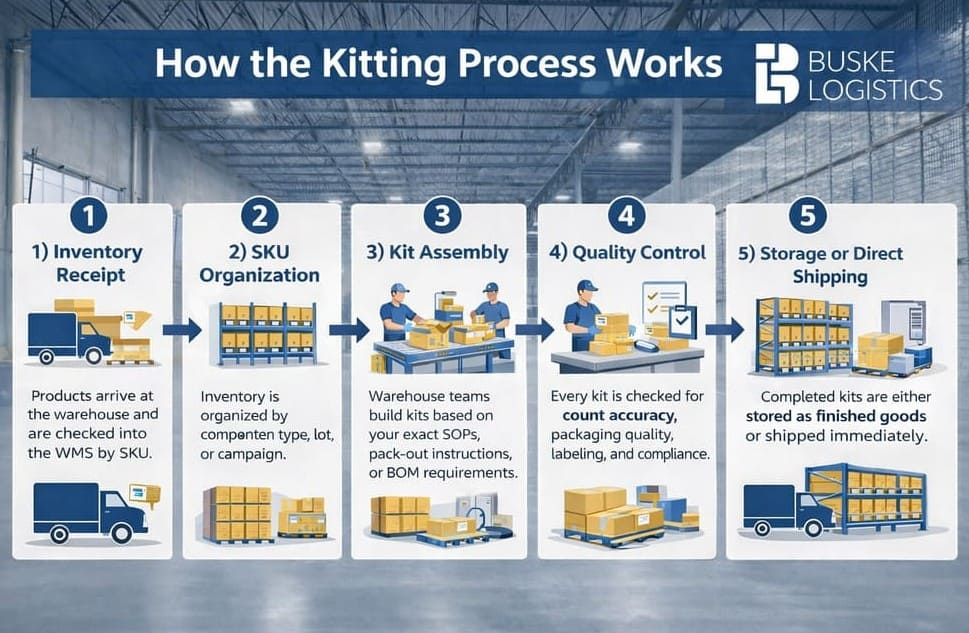
The most efficient kitting fulfillment services follow a simple, repeatable workflow. This standardized process helps improve speed, reduce assembly errors, and ensure consistent output as order volumes scale.
Products arrive at the warehouse and are received, inspected, and checked into the WMS under the correct SKU for accurate inventory tracking.
Inventory is then organized by component type, lot, or campaign to support efficient kit preparation and inventory control.
Warehouse teams build kits based on your exact SOPs, pack-out instructions, or BOM requirements to ensure consistency across every order.
Every kit is checked for count accuracy, packaging quality, labeling, and compliance before it moves to the next stage.
Completed kits are either stored as finished goods for future orders or shipped immediately based on fulfillment requirements.
The kitting process improves efficiency by preparing grouped products in advance, reducing picking time and fulfillment errors. This is especially valuable for fast-moving ecommerce promotions and retail launches.
A smart kitting warehouse operation improves labor flow, slotting efficiency, and overall warehouse productivity by reducing unnecessary movement and simplifying fulfillment steps.
There are two common models:
Pre-Kitting
Best for predictable demand, recurring subscriptions, and standard product bundles that are assembled in advance for faster fulfillment.
On-Demand Kitting
Best for seasonal promotions, personalized orders, and variable kit configurations that require flexibility at the time of order processing.
Benefits of warehouse kitting include:
For brands managing high SKU counts, this directly improves throughput and helps maintain operational consistency during growth.
In manufacturing environments, kitting is used to support production lines with organized component delivery. In manufacturing, kitting ensures production teams receive pre-organized components, minimizing delays and improving workflow consistency.
Instead of operators walking the floor to gather components, every part arrives ready for use. This approach also reduces line-side congestion, lowers picking errors, and helps maintain predictable production throughput.
This supports:
Many businesses often ask where kitting and assembly services overlap within fulfillment operations, especially when both are used to support product preparation before distribution. The difference is simple:
Examples include:
Packaging is a major part of kitting solutions. Packaging and kitting work together to create ready-to-ship products that meet branding, compliance, and customer experience requirements.
This integrated approach also helps reduce handling errors, improve presentation quality, and streamline downstream fulfillment operations. This includes:
For brands in food, beauty, healthcare, and regulated retail, packaging workflows should also align with FDA supply chain and product quality guidance to support product integrity, labeling consistency, and compliance across distribution channels.
For ecommerce brands, kitting fulfillment often drives better shipping economics. It also improves order accuracy, speeds up pick-and-pack workflows, and creates a better unboxing experience for end customers.
Common use cases:
Benefits often include:
Different kitting services are designed to support specific operational needs, from ecommerce fulfillment to retail distribution and manufacturing support. Each service type is tailored to improve workflow efficiency, reduce manual handling, and ensure every kit is assembled accurately for its intended use.
Common kitting services include:
3PL kitting services help businesses reduce operational complexity while improving speed, accuracy, and scalability across fulfillment processes. They also support better inventory control, lower labor costs, and faster turnaround times for bundled or multi-component orders.
The biggest business benefits are:
Custom kitting solutions allow brands to adapt quickly to changing demand, product launches, and marketing campaigns. They also help maintain brand consistency across subscription boxes, promotional bundles, retail-ready displays, and seasonal product assortments.
This is especially useful for:
The best kitting companies offer flexible, scalable solutions that align with your operational goals and long-term growth strategy. They should also demonstrate proven experience in handling your product type, order volume, and customization requirements without compromising speed or accuracy.
When choosing a provider, look for:
For enterprise brands, it also helps to work with providers that follow structured supply chain risk and workflow standards similar to NIST supply chain best practices, especially when managing complex multi-SKU kits and nationwide distribution.
The right provider should fit your growth roadmap, not just your current order volume.
Industries that benefit most from kitting services include a wide range of sectors that require efficient product assembly, packaging, and order preparation as part of their fulfillment operations:
This also helps expand long-tail keyword reach while supporting SEO performance without cannibalizing your existing industry pages.
Outsourcing kitting to a 3PL allows businesses to focus more on growth initiatives while improving overall operational efficiency and fulfillment performance across the supply chain.
Instead of managing labor, warehouse space, quality control, and packaging internally on a day-to-day basis, your team can dedicate more time and resources to priorities such as:
The 3PL takes care of the operational complexity behind the scenes, helping your business run more efficiently.
Buske Logistics delivers customized kitting and assembly solutions designed to support high-volume fulfillment, complex product configurations, and omnichannel distribution.
Our clients choose Buske because we support:
Whether you need warehouse kitting, custom kitting, or scalable kitting fulfillment services, Buske helps simplify operations while supporting long-term growth.
→ Talk with our kitting team today.
Kitting services in logistics are value-added warehouse processes where multiple individual SKUs are grouped, packaged, and assembled into ready-to-ship kits before order fulfillment. Each kit is assigned its own SKU and barcode, allowing it to be picked, packed, and shipped as a single unit rather than as separate items. Kitting improves picking efficiency, reduces order processing time, increases accuracy, and lowers labor and shipping costs.
Common applications include retail bundles, subscription boxes, promotional packs, eCommerce variety packs, point-of-sale (POS) displays, and manufacturing sub-assemblies. Most 3PL providers like Buske Logistics offer kitting as part of an integrated warehousing and fulfillment program.
Kitting and assembly are related but distinct value-added services. Kitting groups multiple finished items into a single packaged unit, for example, combining a shampoo, conditioner, and styling product into one gift set without physically altering the products. Assembly, by contrast, involves physically building or combining components into a new finished product, such as attaching hardware, inserting batteries, applying labels, or constructing point-of-purchase displays.
Many 3PL providers, including Buske Logistics, offer both kitting and light assembly as integrated services within the same facility, allowing brands to consolidate production, packaging, and distribution under one roof and reduce supply chain complexity.
Kitting services are widely used across eCommerce, retail, consumer packaged goods (CPG), manufacturing, health and beauty, food and beverage, nutraceuticals, electronics, and industrial supply industries. Retail brands rely on kitting for in-store displays, club store variety packs at Costco and Sam's Club, and seasonal promotional bundles. eCommerce sellers use kitting for subscription boxes, gift sets, and Amazon FBA prep.
Manufacturers use kitting to pre-stage components for production lines, while nutraceutical and beauty brands use it for sample programs and influencer kits. Any business with bundled SKUs, multi-pack offerings, or production sub-assemblies benefits from outsourced kitting through a 3PL partner.
Kitting improves fulfillment efficiency by reducing the number of pick locations and touches required during order processing, which speeds up cycle times, lowers labor costs, and minimizes picking errors. Instead of pulling 5–10 individual items per order, a fulfillment associate picks one pre-assembled kit, cutting pick time by up to 60% and improving order accuracy to 99.9% or higher.
Pre-built kits also streamline packing, reduce dimensional weight charges, lower carrier costs, and improve OTIF (On-Time In-Full) performance for retail customers. Kitting is especially valuable during peak seasons, product launches, and high-volume promotions, where speed and consistency are critical to meeting demand.
When evaluating a kitting company, look for scalable operations, customization capabilities, strong warehouse management technology (WMS), experienced labor, and seamless integration with broader fulfillment services. Key criteria include facility capacity and flex space, quality control processes, lot and batch traceability, eCommerce and EDI integrations, retailer compliance experience (Walmart, Target, Costco, Amazon FBA), and the ability to support both short-run promotional kits and long-running SKU programs.
Industry experience matters, beauty, nutraceutical, and food brands have very different regulatory and handling requirements. Buske Logistics combines decades of contract warehousing experience with custom kitting and assembly programs, helping brands scale efficiently without operational risk.
3PL kitting services are outsourced solutions where a third-party logistics provider receives bulk inventory, assembles it into customized kits, and manages those kits within an integrated warehousing and fulfillment program. This allows brands to scale operations without expanding internal labor, capital investment, or facility space.
3PL kitting typically includes inbound receiving, component storage, kit assembly, quality inspection, custom packaging, labeling, and outbound shipping for both B2B retail and DTC eCommerce channels. Providers like Buske Logistics support short-run, long-run, and on-demand kitting programs, giving brands the flexibility to launch new bundles, respond to promotions, and meet retailer requirements without disrupting core operations.
Yes, kitting services are widely used in eCommerce fulfillment for product bundles, subscription boxes, gift sets, promotional kits, influencer mailers, and Amazon FBA prep. Pre-assembled kits improve shipping efficiency, reduce dimensional weight, lower parcel costs, and enhance the customer unboxing experience, which directly impacts reviews, retention, and lifetime value.
Integrated 3PL kitting also supports eCommerce platforms like Shopify, Amazon, BigCommerce, and WooCommerce through real-time order management and inventory sync, enabling brands to launch new SKUs and promotions quickly. Buske Logistics combines kitting, eCommerce fulfillment, and retail distribution within a unified operation, giving DTC and omnichannel brands a single partner for complex multi-channel logistics.
Here are the key takeaways you should remember:
If your business needs faster fulfillment, better order accuracy, and a simpler way to scale product bundles, subscription kits, retail sets, or manufacturing pack-outs, Buske can help.
Streamline your operations with scalable kitting and assembly services designed for growth.
Explore our solutions here: Kitting and Assembly Services
Or connect with our kitting expert

Buske Logistics is a Top 20 Private Warehousing 3PL. Let's build a solution for your supply chain.