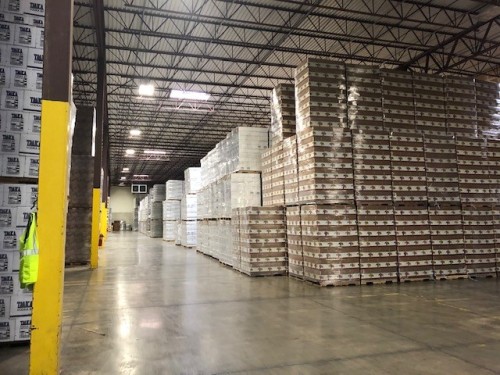
A lot of companies reach out to Buske Logistics at the same turning point: their 3PL’s inventory management has eroded confidence and increased costs to their business. Physical inventory doesn’t match the system, causing a delay in replenishment due to inaccurate days of supply. Excess inventory is marked as expired and thrown out due to inaccurate lot date identification upon receiving.
Based on our experience working with companies such as PepsiCo, Starbucks, and AB InBev, this guide focuses on what tools and resources cut costs with managing inventory.
For additional context on how inventory is handled inside a modern third-party logistics operation, see this overview on 3PL inventory management solutions.
What is Logistics Inventory Management?
Logistics inventory management is the practice of tracking, reporting, organizing, and controlling how inventory moves through your supply chain, from the moment it arrives at a warehouse to the moment orders go out the door. It’s more than basic inventory counting. It’s the operational side of inventory: receiving, putaway, storage, picking, packing, and distribution.
What makes this different from general inventory management is the focus on accuracy. When data is clean, you spend less on labor to manage it and minimize excess inventory, safety stock, and errors. Strong logistics inventory management is a key pillar to minimize cash tied up in excess inventory, order delays, and loss of inventory from robust reporting.
The Biggest Cost Drains in Logistics Inventory Management
Most avoidable costs in a warehouse stem from issues that start small but compound quickly, such as marking a lot date as December 1st, 2026, vs. December 1st, 2025. Using FEFO, a full year’s worth of inventory will be used before it is shipped, which means it will likely become expired and thrown out.
There are many inventory management issues that can increase costs; below are the key issues that we have identified as the main drivers:
- Inaccurate inventory: Weak WMS systems and processes can cause good inventory to be forgotten for months or years, leading to incorrect lot dates. This is a common issue, especially when the receiving pallet has to be manually typed into the system.
- Slow receiving and putaway: Many companies operate under low days on hand during the busy season, thus requiring inbound loads to be crossdocked immediately to an outbound load. If there’s a delay, customers such as Walmart will charge companies fees if a planned order isn’t received in full and on time.
- High carrying costs: This is warehousing 101 and presents a bigger issue if you experience this. If inventory is underrepresented in your 3PL’s reports, a customer may replenish inventory before the reorder point, tying up more cash than necessary. Excess inventory becomes a financial drain, not a safety net.
- Inefficient picking and order errors: Mis-picks, rework, and returns are some of the most expensive fulfillment mistakes. Beyond labor, they directly impact scores, SLAs, and chargebacks. We see this more commonly when a warehouse isn’t laid out correctly or when an operations team moves inventory poorly.
- Lack of real-time visibility: Without clear, live data, teams make decisions based on outdated information. That leads to over-ordering, under-ordering, operational delays, and customer service problems that shouldn’t exist.
- Manual workflows and labor inefficiencies: Paper-based counting, disconnected systems, and repetitive manual tasks slow everything down and will inevitably cause systemic and operational breakdowns. As of the publication date of this blog in 2025, a 3PL or warehouse should never have any manual processes for receiving or shipping inventory. It should all be done using scanning with a WMS.
For teams running on outdated processes, these issues stack up quickly, which is why many operators eventually shift their strategy toward more advanced tools or a 3PL partner with modern systems in place.
Best Inventory Management Solutions to Cut Costs Fast
The fastest savings in logistics rarely come from massive overhauls; they come from tightening the systems that control inventory movement and accuracy. These solutions deliver measurable cost reductions quickly by removing friction, errors, and lag from the operation.
- Dimensionizers: Arguably, the largest component of supply chain costs is transportation, especially in operations that ship via e-commerce. When a shipment’s size and weight are misrepresented, this automatically results in excess costs, as a company is paying for a larger shipment than is actually being shipped. A dimensionizer, such as a Cubiscan, will eliminate the need for manual entry of parcel dimensions and weight.
- Real-time inventory visibility: Live, accurate data eliminates the guesswork that leads to overstock, stockouts, and unnecessary safety stock. A good reporting module in a WMS will tell a client exactly when to order. When teams know exactly what’s available and where it’s stored, decisions become faster and far less expensive. Real-time visibility also keeps you aligned with marketplace SLAs and customer expectations.
- Automation and smart scanning (RFID, barcode, IoT): Automated identification reduces human error, speeds up receiving and picking, and reduces the labor hours typically tied to manual tasks. It also improves accuracy, which in turn reduces returns, rework, and customer service load - all immediate cost wins.
- AI-driven demand forecasting and replenishment: Forecasting has matured far beyond spreadsheets. AI-based models reduce excess inventory by leveraging higher confidence levels derived from historical data, protect against stockouts, and help companies right-size their purchasing. Even the U.S. Department of Commerce notes that data-driven forecasting reduces operational waste and improves supply chain readiness.
- Automated order routing and modern WMS tools: The right warehouse management system removes slowdowns in picking, pack-out, and quality control. Automation reduces labor dependency, minimizes error-driven costs, and keeps throughput predictable even as volumes spike.
- Integrated supply chain data (ERP, eCom, marketplace): Disconnected data is expensive. When your ERP, e-commerce platforms, and marketplace systems feed into one environment, processing becomes faster, reporting becomes cleaner, and you eliminate the delays that lead to mis-ships and costly manual reconciliation.
These solutions pay off quickly because they address the most common sources of waste - slow movement, inaccurate data, and fragmented systems. When combined, they create a fulfillment operation that is leaner, faster, and cheaper to run.
How State-of-the-Art Logistics Companies Manage Inventory Differently
Modern logistics companies don’t rely on “good enough” processes. They build inventory management around accuracy, speed, and early detection, removing problems before they turn into losses. What sets them apart isn’t just the technology they use, but how tightly those tools are embedded into their day-to-day operations.
Cloud-based WMS as the operational backbone
A modern WMS isn’t just software; it’s the engine of the warehouse. It keeps data clean, workflows structured, and every movement logged. This is how high-performing 3PLs maintain consistency even when volumes surge.
Predictive analytics built into planning
Instead of reacting to stockouts or returns, advanced operators use data to anticipate them. Predictive models flag risks early, which reduces emergency labor, last-minute freight, and compliance penalties.
High-accuracy receiving from day one
Cost control starts the moment a shipment arrives. Leading 3PLs use scanning systems and structured intake processes to make sure SKU counts and data are correct before inventory ever touches a pick face.
Automated cycle counting
Instead of shutting down the warehouse for inventory audits, modern 3PLs count continuously in the background. This keeps accuracy above 99% while eliminating the labor spikes and downtime of traditional counts.
Streamlined putaway and picking paths
Inventory doesn’t sit idle. Smart slotting and optimized pick paths reduce worker travel time and lower the labor cost per order - one of the biggest operational savings a shipper can unlock.
Exception alerts that catch problems early
If something looks off like movement patterns, order variance, or unexpected shrink, top providers get notified immediately. Fixing small discrepancies early prevents expensive errors later.
At this level, the warehouse isn’t just executing tasks. It’s running a system designed to be fast, predictable, and cost-efficient.
When to Outsource to a 3PL: Signs Your Inventory Management Needs an Upgrade
Outgrowing your internal inventory processes doesn’t happen all at once - it shows up in patterns. If you’re seeing any of these signs, it usually means the cost of staying in-house is already higher than the cost of partnering with a modern 3PL.
- Your SKU count or order volume has grown faster than your systems.
When teams rely on workarounds just to keep up, accuracy drops and labor hours climb. - Return rates are climbing because of fulfillment errors.
Mis-picks, mislabeled cartons, and inconsistent pack-outs are expensive not just in labor, but in customer confidence. - You don’t have real-time visibility.
If inventory data is updated once or twice a day, decision-making slows down and over-ordering becomes almost unavoidable. - Labor costs keep rising even though output isn’t improving.
This is a classic signal that manual workflows or outdated systems are holding the operation back. - Marketplace SLAs are getting harder to meet.
Late shipments, slow receiving, and inconsistent accuracy put brands at risk of chargebacks and account penalties. - Seasonal peaks overwhelm your team.
If your operation can’t flex when demand jumps, you’re paying for it in overtime, errors, and delays.
At this point, outsourcing isn’t just about solving operational problems - it’s about stabilizing costs and preventing small issues from turning into full-scale disruptions.
How to Choose a Logistics Partner with State-of-the-Art Inventory Management
Not all 3PLs manage inventory the same way. The right partner should lower your costs, protect your accuracy, and give you clearer visibility than you could realistically build in-house. When evaluating providers, these are the markers that separate modern, tech-forward operations from everyone else.
- A proven accuracy rate above 99%
If a provider can’t consistently hit this benchmark, everything downstream including customer experience, returns, and chargebacks become more expensive. - A modern WMS with customer-facing dashboards
You should be able to log in anytime and see your inventory in real time: movement, status, exceptions, and order progress. If visibility is limited or delayed, that’s a red flag. - Automated cycle counting as standard
This keeps inventory clean without shutting down operations or sinking hours into manual audits. - Dimensioner: A dimensioner to automate the shipment dimensions and weight prior to shipping.
- Strong integration capabilities
Your ERP, e-commerce platform, and marketplace systems should connect cleanly - no patchwork, no constant troubleshooting. - Predictive forecasting and planning tools
A partner should help you stay ahead of demand, not chase it. Forecasting accuracy directly affects how much you spend on inventory, storage, and replenishment. - Scalability for volume spikes
Peak season shouldn’t break their system. A good 3PL can ramp up, slot differently, and maintain speed even when volumes climb. - Transparent reporting and operational accountability
You should always know how your inventory is performing - accuracy, speed, exceptions, and cost drivers. If reporting is vague, that’s usually intentional.
A partner who checks these boxes isn’t just providing space and labor - they’re providing a system that protects your margin.
How Buske Logistics Cuts Costs Through Advanced Logistics Inventory Management
Where most companies struggle is exactly where Buske operates best: tightening the day-to-day movements that determine accuracy, speed, and cost. Inventory isn’t managed in isolation - it’s managed through connected systems and floor-level processes that make the operation predictable, even when volume shifts.
- Enterprise-grade system: Every product that enters a Buske facility moves through structured receiving, scanning, and verification steps. Clean intake data prevents the downstream errors that usually lead to returns, rework, and mis-ships.
- High inventory accuracy: Consistently accurate counts reduce carrying costs, limit safety stock, and cut down on the operational overhead tied to fixing preventable mistakes. It also stabilizes fulfillment during peak periods, when accuracy matters most.
- TMS and WMS connected system: Lack of transparency into receiving can cause inventory to be missed on outbound shipments. Buske’s teams use connected systems to keep product flowing quickly into active storage, reducing cut product, and turnaround time.
- Real-time visibility for clearer decision-making: Customers can see their inventory the same way Buske sees it - live, organized, and actionable. This reduces guesswork, supports better forecasting, and prevents the expensive “order blind spots” that come from delayed or siloed data.
- Built for high-volume, multi-channel fulfillment: From DTC to retail replenishment, Buske’s processes are designed to maintain speed and accuracy across different order profiles. This keeps cost per order consistent and prevents the operational drag many brands experience as they scale.
In short, Buske reduces costs by tightening the fundamentals - the places where most operations lose the most money. Better visibility, cleaner data, faster movement, fewer errors. It adds up quickly.
Case Examples: Real Ways Modern 3PLs Cut Costs
Seeing the impact in real scenarios makes the value of better inventory management clearer. These examples show how modern 3PL systems turn common warehouse issues into measurable gains.
- Reduced carrying costs through real-time visibility
A growing e-commerce brand was consistently over-ordering because their team couldn’t see accurate stock levels until the end of each day. After moving to a real-time system, their safety stock dropped by 28% and their monthly storage costs followed. - Improved SKU accuracy and fewer order errors
A retailer operating across multiple sales channels struggled with mismatched counts and mis-picks. With structured receiving, clean slotting, and automated cycle counting, accuracy rose above 99%, and order-related customer complaints fell by nearly half. - Faster order processing during peak periods
Seasonal spikes used to overwhelm a manufacturer’s in-house team, leading to overtime and delayed shipments. By shifting to a 3PL with optimized picking paths and automation built into pack-out, processing speed increased while total labor hours dropped. - Eliminated chargebacks through better data and routing
A brand selling on major marketplaces faced recurring penalties due to late or inaccurate shipments. With cleaner data flow and automated routing rules, chargebacks were reduced significantly and marketplace performance scores improved enough to unlock higher visibility.
These improvements don’t come from isolated fixes. They come from systems that catch issues early, move inventory efficiently, and keep data accurate at every step.
Frequently Asked Questions About Logistics Inventory Management
What is the biggest cost driver in logistics inventory management?
Inaccurate inventory data is the biggest cost driver. When physical inventory doesn’t match the system, companies over-replenish, miss outbound shipments, mismanage lot dates, and carry excess stock that often expires or gets written off. These errors compound quickly across labor, storage, transportation, and chargebacks.
How does poor inventory accuracy impact replenishment decisions?
When inventory counts or days of supply are wrong, replenishment decisions are delayed or triggered too early. This leads to stockouts during peak demand or excess inventory sitting idle in the warehouse. Both scenarios tie up cash and increase operational risk.
Why is real-time inventory visibility critical in modern logistics operations?
Real-time visibility allows teams to make decisions based on what is actually available, not what the system says should be available. Without it, companies over-order, miss crossdock windows, and fail to meet retailer SLAs. In fast-moving environments, delayed data is often worse than no data at all.
How do lot date and FEFO errors increase inventory waste?
Incorrect lot date entry during receiving can cause newer inventory to be shipped before older product. When FEFO logic breaks, entire lots can sit untouched until they expire. This is one of the most common — and costly — inventory management failures in food, beverage, and CPG logistics.
What inventory management tools deliver the fastest cost savings?
Tools that remove manual input deliver the fastest returns. Dimensionizers reduce transportation overcharges, scanning eliminates receiving errors, and WMS reporting improves replenishment timing. These solutions address cost leakage immediately without requiring a full operational overhaul.
When does it make sense to outsource inventory management to a 3PL?
Outsourcing becomes the better option when internal systems can’t maintain accuracy at scale. Signs include rising labor costs without higher output, frequent inventory adjustments, missed retailer deadlines, and limited real-time visibility. At that point, the cost of staying in-house often exceeds the cost of partnering with a modern 3PL.
What should companies look for in a 3PL’s inventory management system?
A modern 3PL should offer real-time WMS reporting, automated cycle counting, scanning-based receiving and shipping, system integrations, and predictive planning tools. Accuracy above 99% and transparent reporting should be standard, not aspirational.
How quickly can companies see cost reductions after improving inventory management?
Many companies see measurable savings within the first few months. Reduced write-offs, lower safety stock, fewer chargebacks, and improved labor efficiency tend to appear quickly once data accuracy and system visibility improve.
The Fastest Route to Lower Logistics Costs
If your inventory feels harder to control, more expensive to manage, or less predictable than it should be, that’s usually a sign the system itself is holding you back. The biggest savings in logistics rarely come from renegotiating rates or adding more labor - they come from tightening the processes that decide accuracy, speed, and visibility every single day.
Companies that modernize their inventory management see the impact quickly: cleaner data, fewer errors, faster order flow, and a fulfillment cost structure that stops creeping upward. And the gap between teams using advanced systems and those relying on outdated workflows is widening fast.
You don’t need to overhaul your entire supply chain. You just need a partner built to manage inventory at the level your business now requires.
If you’re ready to reduce costs, stabilize performance, and remove the operational friction that’s slowing you down, Buske can show you what that path looks like. Contact us today.
.png)
-p-130x130q80.png)