.png)
-p-130x130q80.png)

If you're trying to improve warehouse efficiency, choosing the right warehouse picking method is one of the most important decisions you'll make. The best picking strategy depends on your order volume, SKU mix, warehouse layout, labor availability, and customer requirements. Selecting the right approach can reduce travel time, improve picking accuracy, lower labor costs, and increase fulfillment speed.
The four primary warehouse picking methods are discrete, batch, zone, and wave picking. Each organizes orders differently, making certain methods better suited for specific warehouse operations. Many warehouses also combine multiple picking methods to maximize productivity and adapt to changing order profiles.
At Buske Logistics, we've helped manufacturers, retailers, ecommerce brands, and consumer packaged goods (CPG) companies optimize warehouse operations for more than a century. Through our experience managing high-volume warehousing, fulfillment, inventory management, and distribution, we've seen how the right picking strategy can significantly improve operational performance.
This guide explains how each warehouse picking method works, when to use it, and how to choose the best approach for your operation. It also complements our guides on Case Picking in a Warehouse and Pallet Picking in a Warehouse, which focus on what is picked, while this article explains how warehouse orders are organized and fulfilled.
Warehouse picking methods are the strategies warehouses use to organize, group, and assign customer orders for fulfillment. If you're evaluating ways to improve warehouse productivity, reduce travel time, or increase picking accuracy, selecting the right picking method is just as important as choosing the right warehouse layout or technology.
Unlike picking units, which define what is physically picked (piece, case, or pallet), warehouse picking methods determine how work is assigned to warehouse associates. The right method depends on factors such as order volume, SKU overlap, warehouse size, labor availability, and shipping requirements.
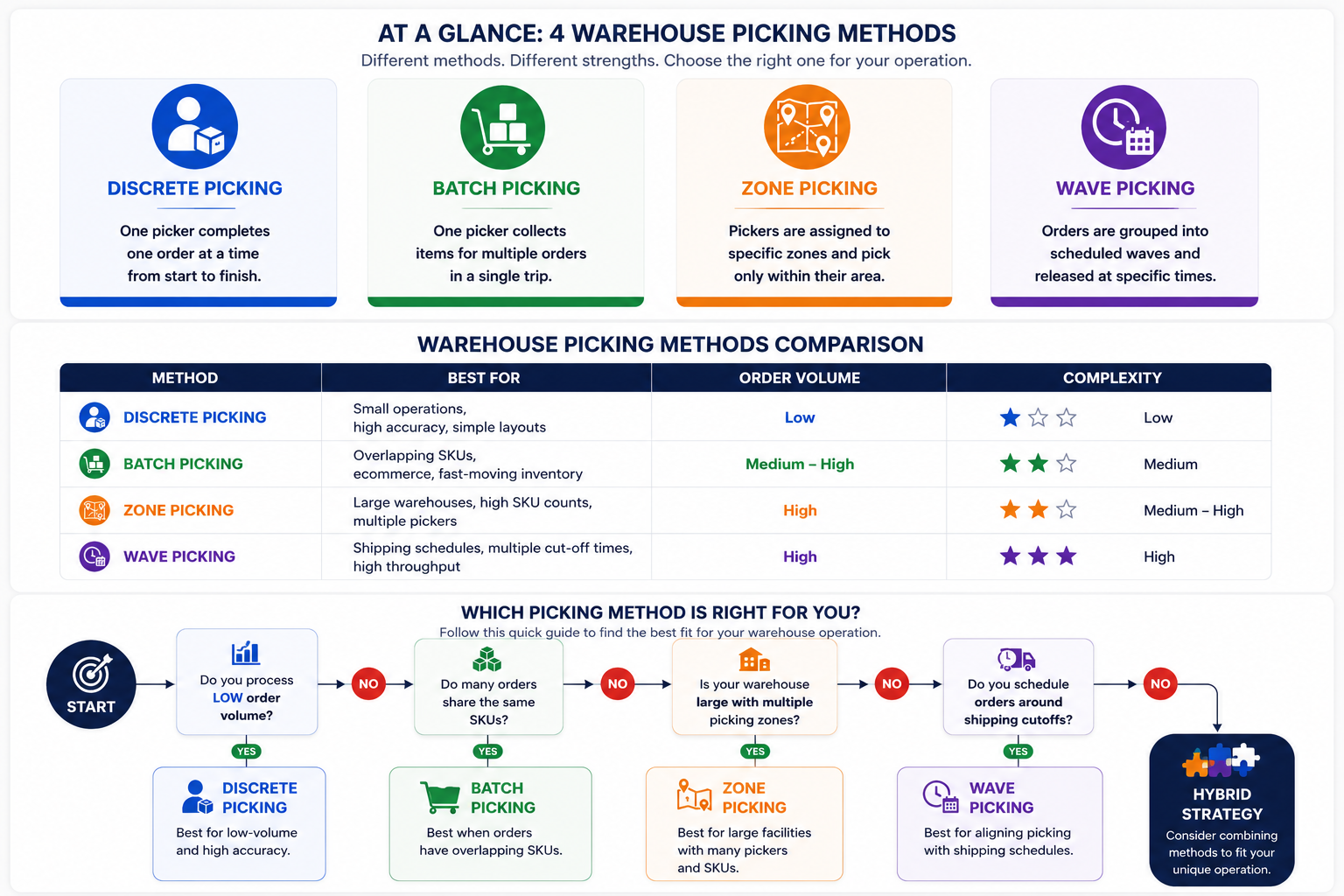
The four main warehouse order picking methods are:
Many distribution centers don't rely on a single picking method. Instead, they combine two or more approaches such as zone and batch picking or wave and zone picking to increase efficiency while supporting different order profiles and customer requirements.
Discrete picking is a warehouse picking method where one warehouse associate picks and completes a single order before moving on to the next. If your operation processes relatively low order volumes or prioritizes picking accuracy over speed, discrete picking is often the simplest and most effective approach.
Because one picker is responsible for the entire order, discrete picking is easy to implement, requires minimal coordination, and simplifies employee training. It's commonly used in smaller warehouses, specialty distribution operations, and businesses fulfilling customized or low-volume orders.
As your warehouse grows, discrete picking may no longer provide the efficiency needed to keep up with demand. Many operations eventually transition to batch, zone, or wave picking or combine multiple methods to reduce travel time and increase throughput while maintaining high levels of order accuracy.
Batch picking is a warehouse picking method where one warehouse associate collects items for multiple orders during a single trip through the warehouse. If your operation fulfills a high volume of orders with overlapping SKUs, batch picking can significantly reduce travel time and improve productivity while supporting more efficient inventory management across the warehouse.
Instead of walking the same warehouse aisles for each individual order, pickers retrieve products for several orders at once before the items are sorted into their respective shipments. This streamlined approach increases throughput and helps warehouses process more orders with the same labor resources.
Batch picking is widely used in ecommerce and retail fulfillment because it allows warehouses to process large numbers of similar orders more efficiently. For even greater productivity, many operations combine batch picking with zone or wave picking to further optimize warehouse workflows.
Zone picking is a warehouse picking method where the warehouse is divided into designated zones, and each warehouse associate is responsible for picking items only within their assigned area. If you operate a large warehouse with a broad SKU assortment, zone picking can improve efficiency by reducing travel time and balancing workloads across multiple pickers.
Orders typically move through the warehouse using one of two approaches. In a pick-and-pass system, an order travels from one zone to the next until every required item has been picked. Alternatively, each zone completes its portion independently, and the order is consolidated before packing and shipping.
At Buske Logistics, we frequently see zone picking combined with batch or wave picking in larger distribution centers. This hybrid approach helps warehouses improve throughput, balance labor more effectively, and maintain consistent fulfillment performance as order volumes increase.
Wave picking is a warehouse picking method where orders are grouped into scheduled "waves" and released for fulfillment at specific times. If your warehouse needs to coordinate order fulfillment with carrier pickups, shipping deadlines, or labor shifts, wave picking can improve scheduling, increase throughput, and keep downstream operations running efficiently.
Instead of releasing orders as they are received, a Warehouse Management System (WMS) organizes them into waves based on criteria such as shipping priority, carrier cutoff times, customer requirements, or outbound routes. Warehouses often combine wave picking with batch or zone picking to maximize productivity while ensuring orders are ready for packing and shipment on schedule.
From our experience managing complex warehouse operations, wave picking is most effective when fulfillment, packing, and transportation teams work in sync. By releasing orders at the right time, warehouses can reduce bottlenecks, improve dock productivity, and ensure shipments leave on schedule.
There's no single warehouse picking method that's best for every operation. If you're evaluating your fulfillment process, the right choice depends on your order volume, SKU mix, warehouse size, labor resources, and shipping requirements. Many warehouses combine multiple picking methods to improve efficiency while adapting to different order profiles.
When selecting a warehouse picking method, ask yourself:
As your operation grows, your picking strategy should evolve with it. For example, a warehouse may begin with discrete picking before introducing batch picking to reduce travel time while allowing warehouse associates to safely operate powered industrial trucks used throughout warehouse operations.
At Buske Logistics, we often help customers implement hybrid picking strategies that combine the strengths of multiple methods. By aligning the picking process with your warehouse layout, inventory profile, and fulfillment goals, you can improve productivity, increase order accuracy, and build a more scalable operation.
Warehouse picking methods and picking units are often confused, but they serve different purposes. If you're designing or improving your warehouse operation, understanding the distinction will help you choose the right fulfillment strategy for your order profile.
Warehouse picking methods determine how orders are organized and assigned to warehouse associates. Picking units, on the other hand, determine what is physically picked to fulfill an order whether that's an individual item, a case, or a full pallet.
For example:
These concepts work together rather than compete with each other. A warehouse may use zone picking as its picking method while fulfilling case-picked orders for retailers or pallet-picked orders for distributors. Likewise, wave picking can be used to organize both piece-picked ecommerce orders and full-pallet replenishment shipments.
If you're deciding what quantity of inventory to pick, explore our guides on Case Picking in a Warehouse and Pallet Picking in a Warehouse. If you're deciding how to organize warehouse workflows, selecting the right warehouse picking method is the key to improving productivity, reducing travel time, and increasing fulfillment efficiency.
Understanding both picking methods and picking units allows you to build a warehouse operation that scales with your business while meeting customer expectations for speed, accuracy, and reliability.
The four main warehouse picking methods are discrete picking, batch picking, zone picking, and wave picking. Each method organizes orders differently based on factors such as order volume, SKU overlap, warehouse size, labor availability, and shipping requirements. Many warehouses combine multiple picking methods to maximize efficiency and adapt to changing order profiles.
Zone picking is a warehouse picking method where the facility is divided into designated zones, and each warehouse associate is responsible for picking items only within their assigned area. Orders either move from zone to zone (pick-and-pass) or are consolidated after each zone has completed its portion. This method is commonly used in larger warehouses with high SKU counts and multiple pickers.
Batch picking allows one warehouse associate to collect items for multiple orders during a single trip, reducing travel time and improving productivity. Wave picking organizes orders into scheduled groups based on shipping priorities, carrier cutoffs, or labor shifts. Many warehouses use both methods together by releasing orders in waves and fulfilling them through batch picking.
Discrete picking, also called single-order picking, is the simplest warehouse picking method. One warehouse associate completes an entire order before moving on to the next, making it an excellent option for smaller operations or businesses where picking accuracy is the highest priority.
There is no single warehouse picking method that is best for every operation. Batch and zone picking generally improve efficiency in high-volume warehouses, while wave picking helps synchronize fulfillment with outbound shipping schedules. Smaller warehouses often benefit from the simplicity of discrete picking, while many larger operations achieve the best results by combining multiple picking methods.
The right warehouse picking method depends on your order volume, SKU mix, warehouse layout, labor resources, and fulfillment objectives. Evaluating these factors and being willing to adopt a hybrid approach as your operation grows can help improve productivity, reduce travel time, and increase order accuracy.
Choosing the right warehouse picking method is essential for improving productivity, reducing labor costs, and delivering orders more efficiently. Whether your operation is best suited for discrete, batch, zone, wave, or a hybrid picking strategy, aligning your fulfillment process with your warehouse layout and customer demand can significantly improve operational performance.
At Buske Logistics, we help manufacturers, retailers, ecommerce brands, and consumer packaged goods (CPG) companies optimize warehouse operations through scalable contract warehousing, inventory management, fulfillment, and distribution solutions. If you're looking to improve your warehouse picking strategy, our team can help you design a solution that supports higher productivity, greater accuracy, and long-term supply chain success. Contact us to learn more.

Buske Logistics is a Top 20 Private Warehousing 3PL. Let's build a solution for your supply chain.