.png)
-p-130x130q80.png)

Warehouse and shipping services combine the storage of your inventory with the processes needed to prepare and move your products to retailers, other facilities, or end customers. When you manage both functions, they need to work as one connected operation. A gap between warehousing and shipping can quickly show up as delayed orders, unnecessary handling, inaccurate shipments, or higher logistics costs.
At Buske Logistics, more than 100 years of logistics experience has shown us that your shipping performance often starts inside the warehouse. Where you hold inventory, how accurately you track it, and how efficiently orders move through the facility all influence what happens when those products are ready to ship.
In this guide, we'll walk you through the types of warehouse and shipping services available, how storage and shipping work together, the benefits of coordinating both, and what you should evaluate when choosing the right provider for your operation.
Warehouse and shipping services combine the storage and management of your inventory with the transportation needed to move those products to their next destination. A 3PL can coordinate both functions, whether you're shipping to a retailer, another distribution facility, or directly to your customers.
The connection between the two matters because decisions you make inside the warehouse directly affect shipping cost, speed, and accuracy. Where your inventory is positioned determines how far products need to travel, while receiving accuracy and inventory visibility affect whether your team can find and release the right products when an order is ready to ship.
When you work with a provider that offers both warehouse and shipping services, your inventory doesn't have to move between disconnected operations before transportation can begin. The same logistics operation can receive and store your products, maintain inventory records, prepare orders, and coordinate their release for outbound transportation.
This is especially important in retail logistics, where your warehouse operation may also need to account for retailer-specific delivery windows, routing instructions, labeling, and other requirements before an order can leave the facility.
Ultimately, you aren't just choosing somewhere to store your products and someone to ship them. You're deciding how efficiently inventory can move from receiving through storage and into outbound transportation as one connected process.
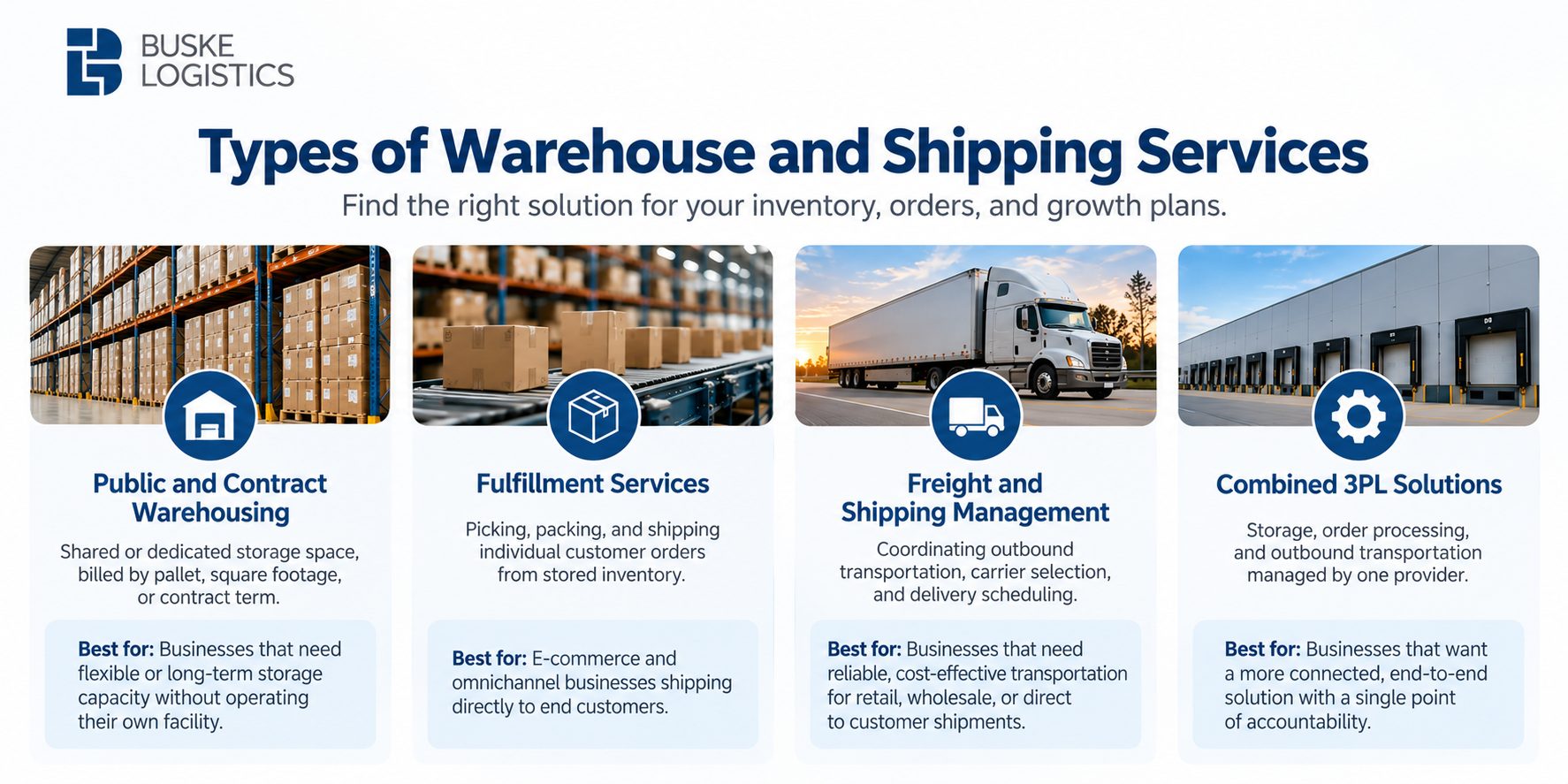
The main types of warehouse and shipping services include public and contract warehousing, fulfillment services, freight and shipping management, and combined 3PL solutions. The right model for your business depends on how much inventory you hold, how orders need to be processed, where products are going, and how much control you want to keep in-house.
Public and contract warehousing both give you access to storage capacity without operating your own facility, but they offer different levels of commitment and customization.
Public warehousing typically provides shared space and resources that you use as needed. It can work when your inventory levels fluctuate or you need additional capacity without committing to a dedicated operation.
Contract warehousing is generally built around a longer-term relationship and can provide dedicated space, labor, processes, and technology based on your requirements. If you have consistent or more complex warehousing needs, this model gives you greater opportunity to design the operation around your inventory and order profile.
Whichever model you use, your retail warehousing operation can include more than storage. Receiving, inventory tracking, replenishment, order preparation, and outbound staging all influence how efficiently your products move to the next destination.
Fulfillment services manage what happens after an order is placed. Your provider retrieves the appropriate inventory, picks the required units, packs the order, applies necessary documentation or labels, and prepares it for shipment.
Your fulfillment requirements can vary significantly depending on who receives the order. Preparing an individual parcel for an e-commerce customer is different from building and labeling pallets for a retail distribution center. Your warehouse processes need to accommodate those differences without compromising inventory or order accuracy.
Freight and shipping management covers the transportation side of the operation, including coordinating outbound shipments, carrier selection, routing, scheduling, and delivery requirements.
Depending on your shipment profile, products may move through small parcel, less-than-truckload, full truckload, or other transportation modes. Your shipping strategy should account for factors such as shipment size, destination, required delivery timing, and customer or retailer requirements.
For retail shipments in particular, retail freight needs to stay coordinated with the warehouse so products are picked, prepared, staged, and available when transportation is scheduled.
A combined 3PL solution brings storage, inventory management, order processing, and outbound transportation coordination under one provider. Instead of managing separate relationships for each stage, you have a more connected process from receiving through shipment.
That connection becomes especially valuable as your operation grows. Changes in inventory, order volume, or shipping requirements can affect several parts of your supply chain at once. When the same provider has visibility into both your warehouse activity and outbound requirements, those changes can be coordinated across the operation rather than handled through separate handoffs.
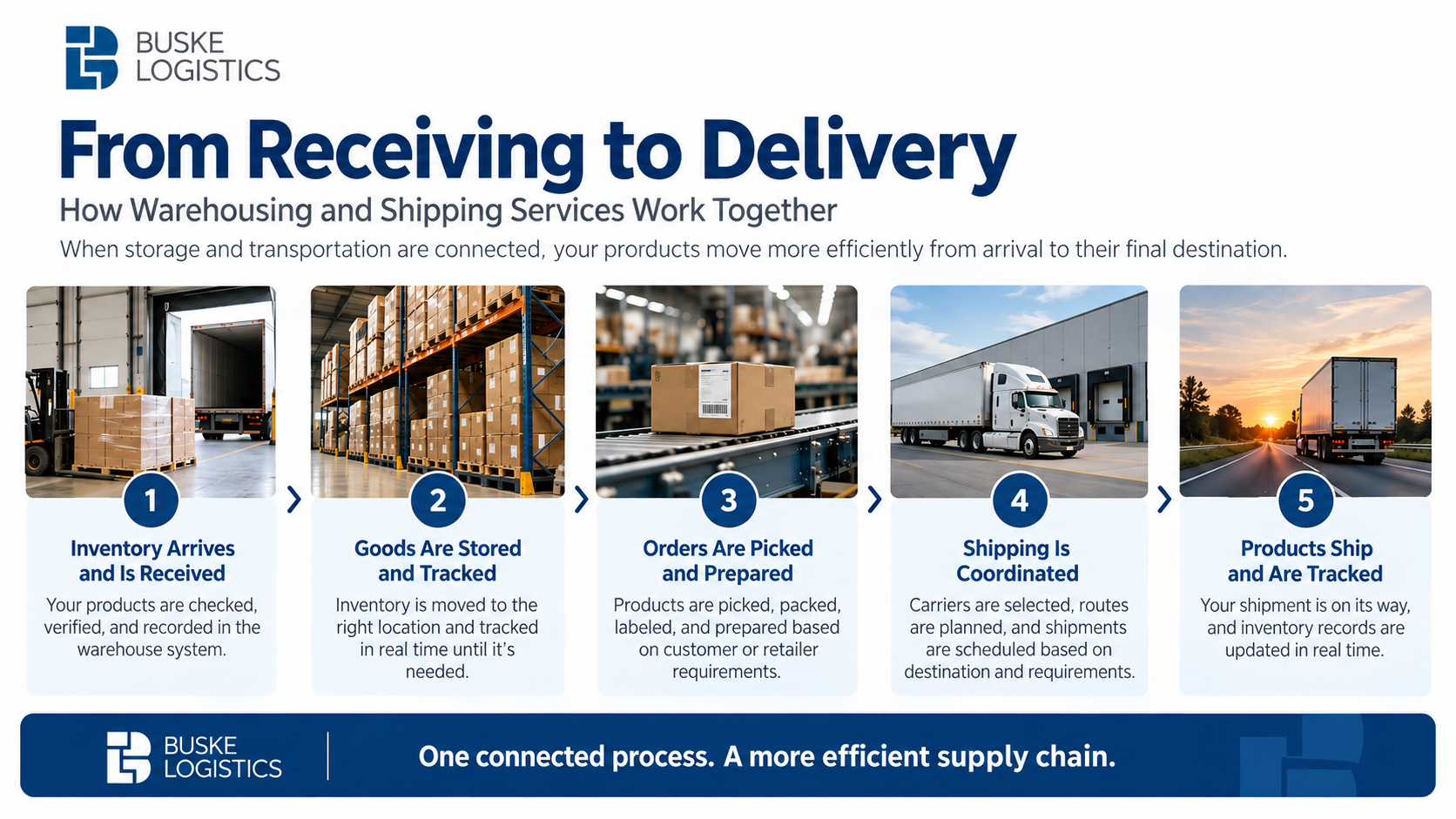
Warehousing and shipping services work together by connecting receiving, inventory management, order processing, and outbound transportation into one continuous process. What happens at each stage affects the next, so coordinating them helps you move inventory from arrival through shipment with fewer unnecessary handoffs.
The process starts when products arrive at the warehouse. Your provider receives the shipment, verifies the goods against the expected quantities, and records the inventory in the appropriate system.
Getting this step right matters downstream. If quantities or product information are inaccurate at receiving, those discrepancies can affect inventory availability and eventually prevent an order from being fulfilled as expected.
Once received, your inventory is moved to the appropriate storage locations and tracked until it is needed.
Good inventory management gives you visibility into what you have and where it is located. That becomes particularly important when you're managing multiple SKUs, higher order volumes, or inventory designated for different customers or retail partners.
When an order or replenishment request comes in, the warehouse retrieves the required inventory and prepares it according to the shipment's requirements.
That could mean picking and packing individual units for parcel fulfillment or building and preparing pallets for a larger retail shipment. The warehouse also needs to account for any packaging, labeling, documentation, or customer-specific requirements before releasing the order.
Once the order is ready, transportation is coordinated based on its destination and shipping requirements. This can include carrier selection, routing, scheduling, and preparing the shipment for pickup.
For retail orders, this handoff can become more complex. Your operation may need to follow routing guides, appointment requirements, labeling standards, EDI or ASN requirements, and other retailer-specific instructions before the shipment leaves the warehouse.
After the shipment leaves, tracking information provides visibility into its movement toward the destination. At the same time, your inventory records should reflect the products that have been picked, allocated, and shipped.
Keeping those records synchronized gives you a more reliable view of remaining inventory and helps prevent future orders from being promised against stock that is no longer available.
When you manage warehousing and shipping through disconnected providers, every transfer of information or inventory creates another handoff. Your warehouse may have an order ready while transportation is still being arranged, or a shipping change may not reach the warehouse team quickly enough to adjust the order.
With coordinated warehousing and shipping services, both sides of the operation can work from the same requirements and timeline. You also have a clearer point of accountability when something needs to be investigated or corrected.
For you, the goal isn't simply to get inventory into a warehouse and eventually out again. It's to create a reliable flow from receiving to storage, order preparation, and shipment so each stage is ready for what comes next.
Warehouse and shipping services can help you reduce operational complexity, control logistics costs, improve order turnaround, and scale without building the same infrastructure in-house. These benefits are strongest when storage and outbound transportation operate as connected parts of your supply chain rather than separate functions.
Managing warehousing and shipping separately means coordinating inventory, order information, schedules, and exceptions across multiple providers or internal teams.
When those functions are connected, you have fewer handoffs to manage. The warehouse team can prepare orders around outbound requirements, while the shipping side has visibility into when products will actually be ready for release.
You also gain a clearer point of accountability. If an order is delayed, you don't have to spend as much time determining whether the issue occurred during storage, order preparation, staging, or the transportation handoff.
The lowest warehouse rate or shipping rate doesn't necessarily result in the lowest overall logistics cost. You need to consider what happens between those services as well.
Poor coordination can create additional handling, unnecessary inventory transfers, inefficient transportation, detention, or shipments originating farther from their destination than necessary.
Where you store inventory also affects what it costs to move. Positioning products closer to the retailers, distribution centers, or customers you regularly serve can reduce transportation distance and give you more practical shipping options.
The U.S. Department of Transportation's Bureau of Transportation Statistics tracks freight movement and transportation activity across the U.S., reflecting how transportation remains a significant part of the broader movement of goods through supply chains.
Shipping speed doesn't begin when a truck arrives at the dock. It depends on how quickly your warehouse can locate inventory, process the order, complete any required preparation, and stage the shipment.
When your warehousing and shipping processes are coordinated, transportation decisions can be made with better visibility into inventory location and order readiness.
For example, knowing exactly where inventory is stored and when it will be ready can help your team schedule transportation around actual warehouse activity instead of relying on disconnected updates.
Your storage and shipping requirements are unlikely to remain exactly the same throughout the year. Seasonal peaks, promotions, new customers, retail expansion, or business growth can increase both the amount of inventory you hold and the volume you need to ship.
Outsourcing warehouse and shipping services can give you room to adjust without immediately investing in additional facilities, warehouse labor, equipment, and transportation resources yourself.
That flexibility is particularly valuable when your growth affects both sides of the operation at once. More inventory usually means more receiving and storage activity, while higher sales create additional picking, staging, and outbound volume. A coordinated 3PL model allows those requirements to be planned together rather than scaled independently.
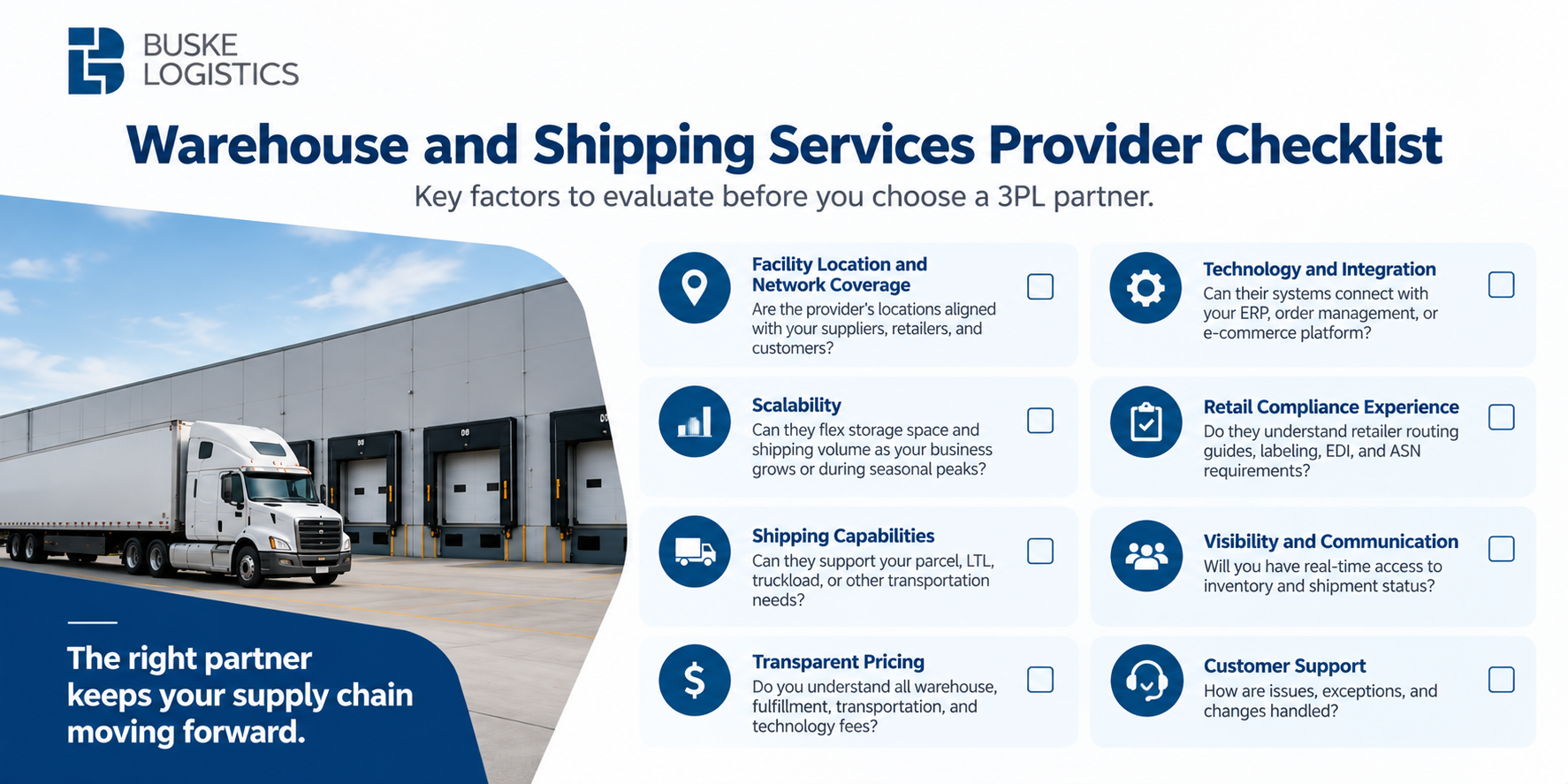
The right warehouse and shipping services provider should fit your inventory, shipping network, technology, growth plans, and customer requirements. Price matters, but evaluating providers on rates alone can overlook operational differences that affect your total logistics cost and service performance.
Start by looking at where your inventory needs to enter the network and where it ultimately needs to go.
A warehouse located near your suppliers may simplify inbound transportation, while a facility closer to your largest retailers or customer markets may help reduce outbound distance. If you serve customers across several regions, you may also need to determine whether one warehouse is sufficient or whether distributing inventory across multiple locations makes more sense.
Don't evaluate the warehouse address in isolation. Consider how each location fits into your entire flow of goods:
Suppliers - Warehouse - Retailers or Customers
The goal is to position inventory where it can support both efficient storage and practical outbound transportation.
Your provider's systems should give you reliable visibility into inventory and order activity while connecting with the technology you already use.
Depending on your operation, that may require integration with your ERP, order management system, e-commerce platform, or other business systems. Ask prospective providers how information moves between systems, how frequently inventory records update, and what visibility you'll have once an order enters the warehouse.
Technology matters because shipping decisions depend on accurate warehouse information. If your system says inventory is available when the physical product isn't actually there, even a well-planned shipment can fail before it reaches the dock.
Look beyond the volume you're shipping today.
Your provider should be able to explain how it handles changes in storage requirements, inbound activity, order volume, and outbound shipments. This is especially important if your business experiences seasonal peaks, promotions, new product launches, or rapid growth.
Ask what happens when your operation needs significantly more pallet positions or begins processing substantially more orders. Understanding those constraints before signing an agreement can help you avoid discovering capacity limitations during your busiest period.
If you ship to major retailers, provider selection becomes more than a warehousing and transportation decision. Your operation also needs to meet the requirements established by each retail partner.
Those requirements can include routing guides, carton and pallet labels, packaging standards, appointment scheduling, EDI transactions, Advance Ship Notices (ASNs), and other shipment-specific instructions. The exact requirements vary by retailer.
A provider with retail compliance capabilities can help you build those requirements into warehouse and shipping processes instead of addressing them only after an order has been prepared.
This matters because a shipment can leave your warehouse accurately picked and packed and still create problems if it doesn't meet the retailer's receiving requirements. Our guide to retail compliance explains these requirements and their role in avoiding preventable deductions, delays, and receiving issues.
Before making your decision, ask prospective providers questions that reveal how your operation would actually work:
The provider that fits your operation isn't necessarily the one offering the most services. You need a partner whose facilities, systems, processes, and shipping capabilities match how your inventory actually moves and can continue supporting that flow as your requirements change.
Warehouse and shipping services combine inventory storage and management with the processes needed to move your products to their next destination. A 3PL may handle receiving, storage, order processing, fulfillment, and outbound transportation coordination within one operation.
Common options include public and contract warehousing, fulfillment services, freight and shipping management, and combined 3PL solutions. The right option depends on how much inventory you store, how your orders are processed, where your products need to go, and how much logistics support you want to outsource.
Bundling warehousing and shipping can reduce the handoffs between storing your inventory and moving it outbound. When one provider coordinates both functions, your warehouse and shipping activities can work from the same inventory information, order requirements, and timelines, giving you a clearer point of accountability when issues occur.
Look at the provider's facility locations, technology and integration capabilities, ability to scale, shipping capabilities, and experience with your specific operational requirements. If you ship to retailers, you should also evaluate whether the provider can support routing guides, labeling, EDI, ASN, and other retail compliance requirements.
Yes. A 3PL can manage your inventory inside the warehouse and coordinate the outbound movement of your orders as part of the same logistics operation. Depending on the provider and your requirements, this can include receiving, storage, inventory management, picking and packing, shipment preparation, and transportation coordination.
Outsourcing may make sense when managing storage capacity, warehouse labor, technology, fulfillment, or outbound shipping internally is becoming difficult to scale. It can also be useful when you're entering new markets, experiencing seasonal volume changes, or need specialized capabilities such as retail compliance without building the infrastructure yourself.
Your warehouse and shipping services work best when inventory storage, order preparation, and outbound transportation are managed as one connected process. The right 3PL can help you reduce unnecessary handoffs, maintain better visibility, and build an operation that can adjust as your storage and shipping requirements change.
For a broader look at how these functions fit into your supply chain, explore our Retail Logistics guide, or learn more about Buske's Retail Warehousing and Retail Freight solutions.
Ready to evaluate the right warehousing and shipping model for your operation? Contact Buske Logistics to discuss your inventory, facility, and shipping requirements with our team.

Buske Logistics is a Top 20 Private Warehousing 3PL. Let's build a solution for your supply chain.


