.png)
-p-130x130q80.png)
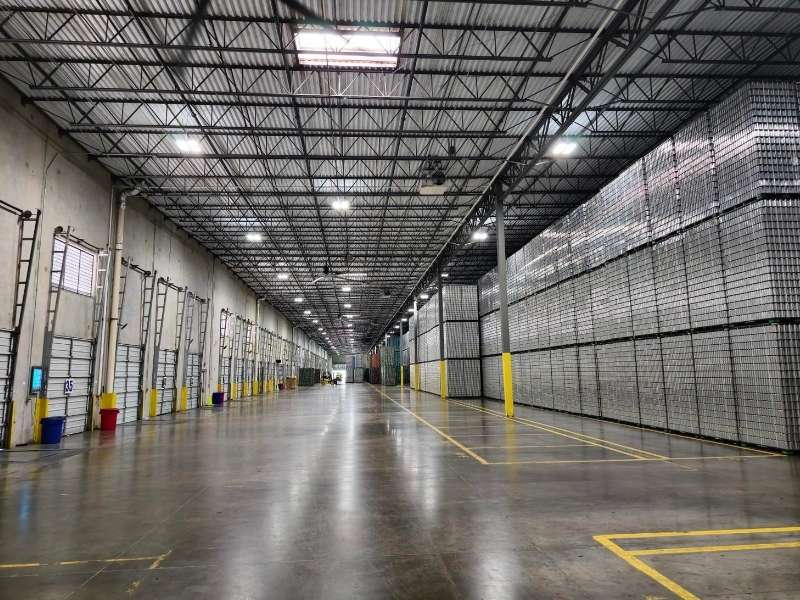
A warehouse distribution center (DC) is a fulfillment facility that receives inventory from suppliers or manufacturers, stores it, and then picks, packs, and ships orders to retailers, businesses, or end consumers. Unlike a traditional storage warehouse, a distribution center is engineered for high-velocity throughput minimizing the time inventory dwells inside the building before moving to its next destination. Distribution centers are the operational backbone of modern supply chains, enabling businesses to serve customers across large geographic regions from strategically positioned inventory hubs.
The term "warehouse distribution center" combines two historically distinct functions: warehousing (the storage of goods) and distribution (the movement of those goods toward their final destination). In practice, most modern facilities blend both storing inventory strategically while simultaneously executing high-velocity order fulfillment. The key distinction from a pure storage warehouse is the emphasis on throughput speed: goods in a DC are meant to move, not sit.
A well-positioned DC transforms supply chain economics. Instead of shipping products individually from a factory or single central location with long transit times and high per-unit shipping costs, businesses use a network of DCs to position inventory close to their customers. Orders are then fulfilled from the nearest DC, cutting delivery times from days to hours and per-shipment costs by 30–50%.
These three terms are often used interchangeably but describe meaningfully different operations. Understanding the distinction helps businesses specify exactly what they need when evaluating logistics partners.
Most 3PL operators including Buske Logistics, operate multi-function facilities that perform all four functions under one roof, configuring the appropriate mix for each client. A consumer goods brand might use the same building for long-term safety stock storage (warehouse), case-pick replenishment to retail stores (DC), and individual order fulfillment for their DTC website (fulfillment center). The operational model is shaped by the client's channel mix and service requirements.
Understanding the physical flow of goods through a DC helps businesses evaluate a potential 3PL partner's operational capability and identify where service breakdowns typically occur. Here is the complete operational lifecycle of inventory through a modern distribution center:
Inbound shipments arrive at the receiving dock. Staff verify quantities against the Advanced Shipment Notice (ASN), inspect for damage, capture lot/serial/expiry data, and book inventory into the WMS. Speed and accuracy here determine how quickly inventory becomes available to fulfill orders, as a slow receiving process creates a hidden stockout even when physical goods are in the building.
Once received, inventory is directed to storage locations by the WMS, placing fast-moving SKUs close to outbound staging, heavy items at floor level, and hazardous materials in compliant zones. Intelligent slotting reduces travel distance for pickers by 15–25%, significantly impacting labor efficiency at scale.
Orders flow into the DC from EDI (retail partners), ecommerce platforms, or ERP systems. The WMS batches orders into pick waves optimized for efficiency, grouping orders by zone, carrier, or ship time to minimize travel and maximize throughput. Wave planning is where the difference between a 300-order/hour operation and an 800-order/hour operation is often made.
Pickers travel the warehouse floor retrieving items per the WMS pick list, with each pick event confirmed via barcode scan to prevent errors. Pick methods include single-order pick (one picker, one order), batch picking (one picker, multiple orders simultaneously), zone picking (each picker owns a zone, passes tote forward), and wave picking (coordinated across multiple zones). Advanced DCs supplement human picking with autonomous mobile robots (AMRs) that bring shelves to stationary pickers, increasing throughput 2–4x.
Before packing, many orders pass through a VAS station for kitting, labeling, gift wrapping, retail compliance preparation (price tagging, hang tags, carton marking), or custom inserts. This is where 3PL flexibility, the ability to configure VAS workflows per client, creates significant value for brands with complex presentation requirements. See Buske's kitting & assembly services.
Picked items are packed into the optimal carton size, minimizing dimensional weight charges by eliminating void space while ensuring adequate protection. Cartonization logic embedded in modern WMS systems automatically selects the right box and generates packing instructions, reducing both material cost and shipping dimensional weight charges.
Packed cartons are labeled, sorted by carrier and destination zone, and staged on outbound docks for carrier pickup. The TMS (Transportation Management System) selects the optimal carrier and service level based on cost, transit time, and SLA requirements. Real-time tracking data is transmitted to the order management system and the end customer.
Returned goods are received, inspected, graded (sellable, refurbish, liquidate, dispose), and processed back into inventory or routed for disposition. Returns processing speed and accuracy directly affect available-to-sell inventory and working capital recovery, an often underinvested capability that world-class DCs treat with the same rigor as outbound fulfillment.
The strategic case for distribution centers rests on a fundamental supply chain principle: proximity to customers reduces cost and improves service simultaneously, a rare combination in business where improvements typically come with trade-offs. Here's how DCs deliver this dual benefit:
Ground parcel shipping from a DC within 500 miles of a customer delivers in 1–2 days. Shipping the same order from a single central facility on the opposite coast takes 4–7 days. In the age of Amazon Prime expectations, the DC network is what makes competitive delivery times economically possible for non-Amazon businesses.
Shorter distance shipments cost less. Moving freight in large truckloads from manufacturers to DCs (inbound transportation, optimized for efficiency) and then shipping small parcel orders from DCs to customers (outbound, optimized for proximity) exploits the most cost-effective rate structures for each leg of the journey. This hub-and-spoke model typically delivers 30–50% lower per-unit delivery costs versus shipping individual orders from a single centralized location.
Distributed DC networks reduce single-point-of-failure risk. When a weather event, carrier disruption, or facility issue affects one DC, orders can be rerouted to adjacent DCs with minimal service impact. Businesses relying on a single warehouse have no such fallback, a facility disruption halts all fulfillment simultaneously.
Major retailers such as Walmart, Target, Costco, and Amazon Vendor Central impose strict compliance requirements on their suppliers, including specific labeling formats, packing standards, EDI document requirements, routing guide compliance, and OTIF (On-Time In-Full) performance targets that are often enforced through financial chargebacks. Professional DC operations are built around meeting these requirements at scale; in-house operations without dedicated retail compliance expertise routinely incur 2–5% of invoice value in chargeback fees.
Once a business decides it needs DC capabilities, the fundamental build-vs.-buy decision follows: operate a private DC or partner with a 3PL that provides DC services as part of its network? For most businesses below enterprise scale, the economics and speed-to-capability advantages of 3PL DCs are compelling.
Buske Logistics operates a strategically distributed network of warehouse distribution centers across North America, positioned to serve fast-growing companies and large enterprises that need DC capabilities without the capital investment, build time, and management burden of private DC operations. Our facilities combine advanced WMS technology, experienced fulfillment teams, and multi-channel distribution capabilities that would take years and tens of millions of dollars to replicate internally.
A warehouse distribution center (DC) is a fulfillment facility that receives inventory from suppliers or manufacturers, stores it, and then picks, packs, and ships orders to retailers, businesses, or end consumers. Unlike a pure storage warehouse, a DC is engineered for high-velocity throughput, minimizing the time inventory spends inside the facility before moving to its destination. DCs are the operational backbone of distributed supply chain networks, enabling businesses to position inventory close to customers for faster, cheaper delivery.
A warehouse primarily stores inventory for extended periods, with emphasis on storage capacity and organization, while a distribution center stores inventory more briefly and primarily executes order fulfillment, with emphasis on throughput speed and order accuracy. DCs are characterized by frequent inbound and outbound movements, picking and packing operations, and tight integration with order management systems. Most modern 3PL facilities combine both functions, calibrating the balance based on client needs.
A distribution center works through an 8-step operational cycle: (1) Inbound receiving and inventory inspection; (2) WMS-directed putaway to storage locations; (3) Order receipt and wave planning; (4) Picking (individual items retrieved per order); (5) Value-added services (kitting, labeling, customization); (6) Packing into the optimal carton; (7) Carrier selection, labeling, and outbound shipment; and (8) Returns processing. Every step is managed by a Warehouse Management System (WMS) that tracks inventory at the bin level and directs operations in real time.
Using a 3PL distribution center eliminates the capital investment (typically $5M–$100M+) and 12–24 month build time required for a private DC. Businesses gain immediate access to operational expertise, WMS technology, and established carrier relationships. 3PL DC costs scale with volume, meaning you pay for what you use rather than fixed costs regardless of utilization. For businesses in growth mode, 3PL DCs provide the geographic flexibility to reposition inventory as customer demand patterns evolve, without the capital commitment of owned or leased private facilities.
Cross-docking is a distribution strategy where inbound freight arriving at a DC is transferred directly to outbound trucks, with minimal or no storage time in between. Goods are sorted and consolidated by outbound destination on the receiving dock and loaded onto outbound trailers without ever being placed into storage locations. Cross-docking is used for high-velocity, time-sensitive goods (fresh produce, promotional merchandise, retail replenishment) where the cost of storage is not justified and speed to destination is paramount. It requires precise coordination of inbound and outbound schedules and real-time WMS support.
DC location selection is driven by: customer population density (position inventory within 1–2 days ground transit of your highest-demand markets), transportation infrastructure (proximity to major interstates, rail terminals, and air hubs), labor market availability and cost (warehouse labor costs vary 30–50% across U.S. markets), real estate availability and cost (major logistics corridors command premium rents), and tax/regulatory environment. Most businesses benefit from starting with demand mapping, plotting their orders geographically over the past 12 to 24 months to identify optimal DC positions before evaluating specific markets. See Buske's warehouse distribution network design guide for a complete framework.

Buske Logistics is a Top 20 Private Warehousing 3PL. Let's build a solution for your supply chain.