.png)
-p-130x130q80.png)
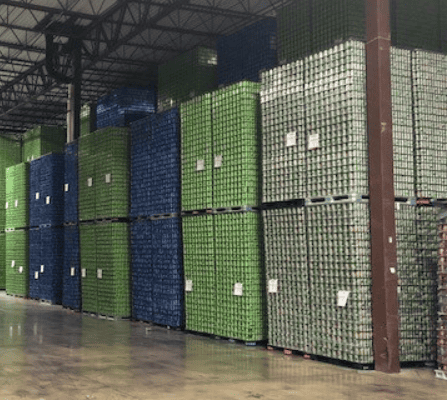
Vendor compliance means meeting the shipping, labeling, documentation, and delivery standards retailers establish for their suppliers. If your business supplies major retail chains, these requirements directly affect whether your products are accepted, how quickly they're processed, and whether you face costly chargebacks.
A missing ASN, incorrect pallet label, or missed delivery appointment can reduce your margins and affect your vendor scorecard. Consistent compliance, however, helps protect retailer relationships and keeps inventory moving.
With more than 100 years of logistics experience, Buske Logistics understands how warehouse execution, transportation coordination, and retail compliance influence supplier performance.
This guide explains how retail vendor compliance works, what vendor manuals require, common violations, best practices, and the services available to help you manage compliance as your business grows.
Vendor compliance is the practice of meeting the standards a customer sets for its suppliers. In retail, this means following a retailer's requirements for labeling, electronic data interchange (EDI), advance ship notices (ASNs), packaging, shipping routes, and delivery. Meeting these standards helps ensure your shipments are accepted without avoidable penalties.
If your business supplies multiple retailers, each may have different requirements. A shipment that meets one retailer's standards might violate another's, even when the products and quantities are identical.
That's why an effective vendor compliance guide goes beyond documenting requirements. You need processes that help your warehouse, transportation, and compliance teams apply the correct instructions to every order.
An important distinction: Vendor compliance can also refer to procurement and risk management, where a company evaluates its own suppliers against internal policies or regulatory standards. This guide focuses specifically on retail vendor compliance - the requirements your business must meet when supplying retailers.
Vendor compliance is important because it protects your profit margins, strengthens retailer relationships, and helps ensure your products reach store shelves without unnecessary delays. When you're supplying major retailers, even small shipping or documentation errors can affect your costs and overall vendor performance.
Retailers may issue chargebacks or deductions when shipments fail to meet their requirements. Incorrect labels, missing documentation, and missed delivery appointments can turn otherwise profitable orders into unexpected expenses.
Maintaining consistent compliance helps you reduce preventable retail chargebacks and protect your margins.
Retailers often evaluate suppliers using vendor scorecards that track delivery performance, order accuracy, and compliance violations.
When you consistently meet their standards, you demonstrate reliability and give retail partners greater confidence in your ability to fulfill orders.
Noncompliant shipments can create receiving delays, require additional handling, or even be rejected.
Following retailer requirements helps your shipments move through distribution centers more efficiently, reducing disruptions that could affect inventory availability.
Adding new retailers means managing more vendor manuals, shipping instructions, and documentation requirements.
With standardized compliance processes, you can expand into new retail accounts and distribution channels without rebuilding your operations for every customer.
The bottom line: Vendor compliance isn't just about avoiding penalties. It's about building a reliable supply chain that protects your margins, supports retailer partnerships, and makes growth easier to manage.
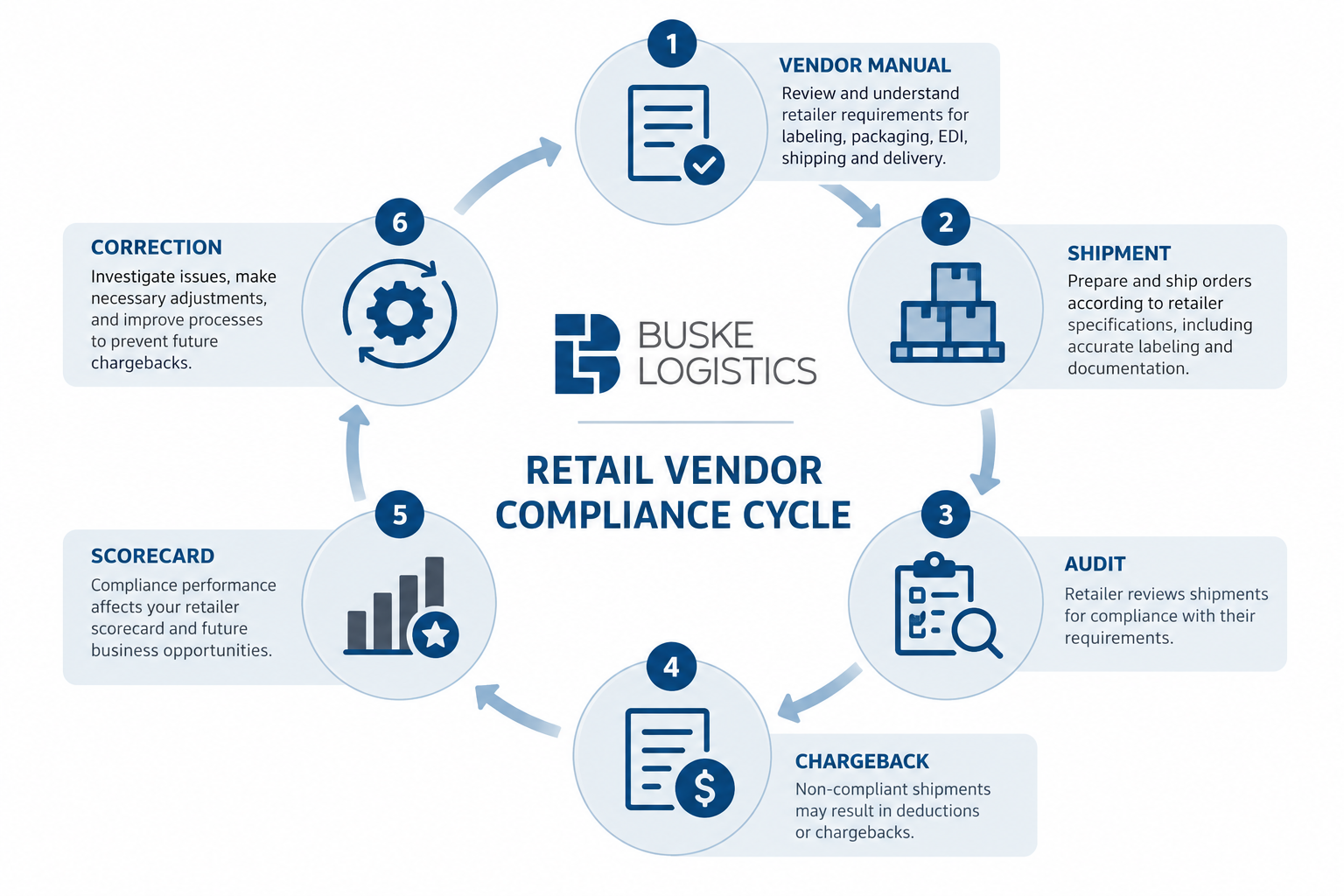
Retail vendor compliance follows a process in which retailers establish supplier requirements, vendors prepare shipments according to those standards, and retailers evaluate performance after delivery. Understanding this process helps you identify where violations occur and how to prevent them.
Each retailer establishes its own standards through a vendor compliance manual or supplier portal. These instructions explain how you must prepare, document, ship, and deliver orders.
Before fulfilling a purchase order, your team needs access to the retailer's latest requirements.
Your warehouse and transportation teams translate those requirements into daily operations, including:
The goal is to verify compliance before your shipment leaves the facility.
When your shipment arrives, the retailer checks it against the purchase order and applicable vendor requirements.
This may include verifying quantities, scanning labels, matching ASN information, and reviewing delivery performance.
If your shipment fails to meet requirements, the retailer may issue a chargeback, deduct fees, or record a compliance violation.
These results may also appear on your vendor scorecard, giving retailers a way to evaluate supplier performance over time.
For a closer look at the financial impact, see our guide to retail chargebacks.
Your compliance process shouldn't end once the shipment is delivered.
Review chargebacks and scorecard results, dispute incorrect deductions when supported by documentation, and identify recurring problems.
For example, if one distribution center repeatedly receives shipments with incorrect pallet labels, investigate the labeling workflow rather than treating each deduction as an isolated incident.
The key is to make vendor compliance a continuous process: follow requirements, verify shipments, review performance, and correct issues before they affect future orders.
A vendor compliance manual is a document or online portal where a retailer outlines the requirements suppliers must follow when processing orders, preparing shipments, and delivering products. It serves as your reference for meeting retailer expectations and avoiding compliance violations.
Because requirements differ between retailers, your team needs to understand and apply the correct manual for every retail account.
Most retailer manuals address several operational areas:
For an official example of how retailers communicate supplier expectations, review Walmart's Supplier Requirements. Always consult the current requirements for your specific retailer and supplier program.
Having access to the manual isn't enough. You need to turn its instructions into processes your team can follow consistently.
Start by assigning someone to manage each retailer's requirements. Track manual revisions, maintain a centralized reference library, and convert relevant instructions into warehouse and transportation checklists.
For example, if a retailer updates its pallet-labeling requirements, your team should update the applicable labeling procedures before the next shipment is prepared.
A vendor compliance manual covers the retailer's broader supplier requirements, while a routing guide focuses specifically on how shipments must move through the transportation process.
Routing guides typically address approved carriers, shipping methods, freight terms, and delivery instructions.
For a detailed breakdown, see our routing guide logistics and retail compliance guide.
Remember: Retailer manuals can change. Always verify that your team is working from the latest published version rather than relying on outdated instructions.
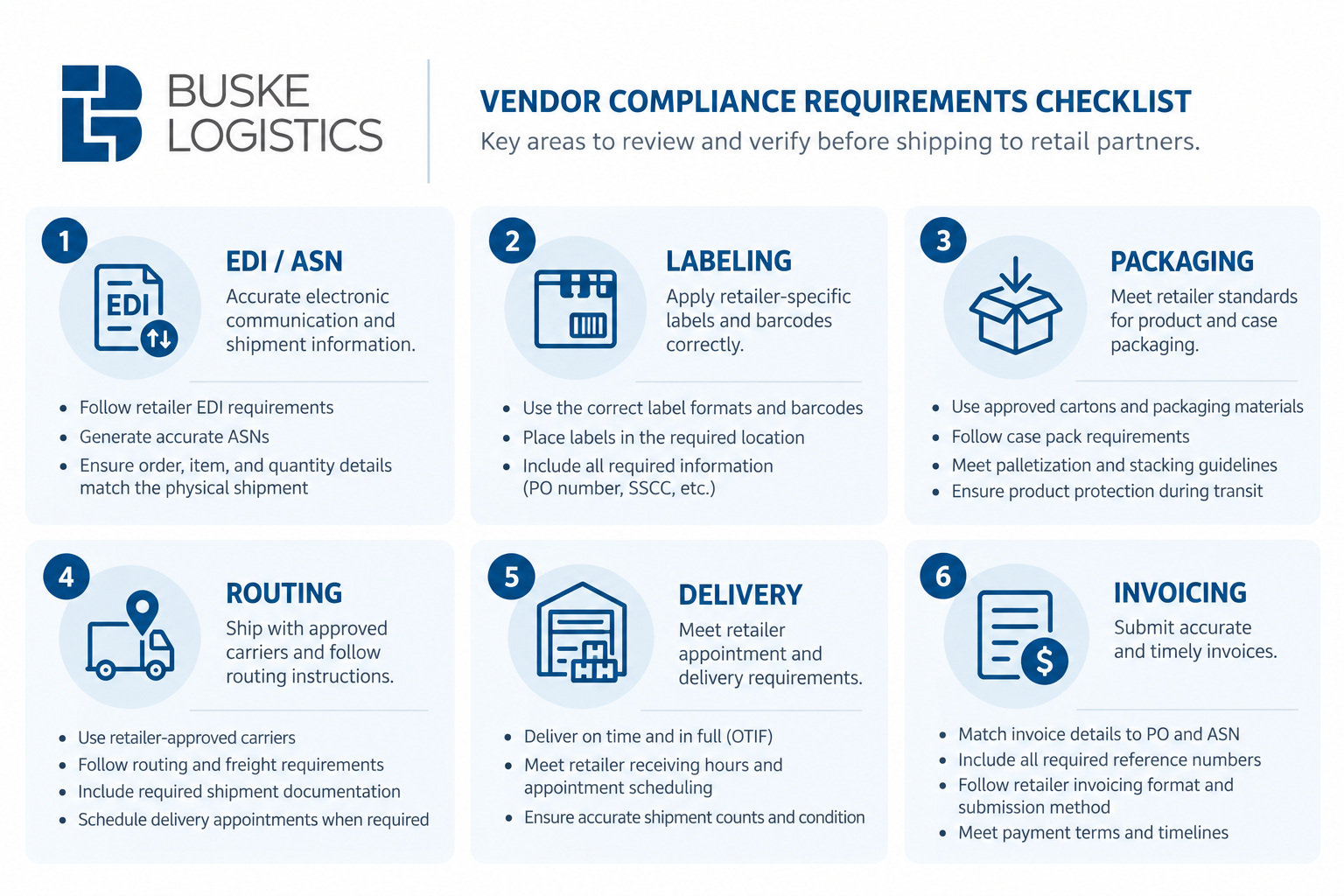
Vendor compliance requirements are the shipping, documentation, packaging, and delivery standards retailers expect suppliers to meet. While specific rules vary by retailer, most programs focus on six areas that directly affect how your orders are processed and received.
Retailers often require electronic data interchange (EDI) to exchange purchase orders, invoices, and shipment information.
Your advance ship notice (ASN) must accurately reflect what you're shipping and be submitted within the retailer's required timeframe. Missing or incorrect information can delay receiving and trigger compliance violations.
Your cartons and pallets must carry labels that meet the retailer's specifications.
These requirements may include barcode formats, shipment identifiers, label placement, and information that matches the purchase order. Incorrect labels can create scanning problems and additional handling at the receiving facility.
Retailers establish packaging standards to support safe handling and efficient receiving.
Depending on the retailer, these may cover case-pack quantities, pallet configurations, stacking methods, and weight or height limits.
Your shipments must follow the retailer's transportation instructions, including approved carriers, shipping methods, and freight terms.
Using an unauthorized carrier or failing to follow the designated shipping process may result in additional costs or deductions.
Retailers may require scheduled delivery appointments and measure suppliers against on-time, in-full (OTIF) expectations.
Arriving outside the approved delivery window or delivering incomplete quantities can affect your compliance performance and vendor scorecard.
Your invoices and shipping documents must accurately match the purchase order and delivered quantities.
Discrepancies can delay payment, create reconciliation work, and lead to deductions.
For a broader explanation of retailer requirements and compliance processes, read our retail compliance guide.
The key takeaway: Meeting vendor compliance requirements means coordinating your warehouse, transportation, and documentation processes—not simply checking paperwork before delivery.
Vendor compliance examples show how labeling errors, inaccurate shipment information, and missed delivery appointments can lead to retailer penalties. Understanding these situations helps you identify potential problems before they affect your shipments.
The following examples are illustrative scenarios, not the published requirements or penalty policies of any specific retailer.
Your warehouse prepares a shipment for a major retailer, but several pallet labels are missing a required shipment identifier.
When the shipment arrives, the retailer flags the labeling discrepancy during receiving. Your business may face additional handling fees or a compliance deduction.
How to prevent it: Validate label formats against the retailer's current manual and scan labels before loading.
Your team ships 500 cartons, but the advance ship notice lists only 480. The discrepancy creates problems when the retailer attempts to reconcile the shipment.
Depending on the retailer's policies, this could delay receiving or result in a chargeback.
How to prevent it: Reconcile ASN data with actual shipped quantities and verify submission before the required deadline.
Your carrier arrives at a retailer's distribution center outside the scheduled delivery window.
The retailer may reschedule, refuse the delivery, or assess a penalty, creating additional transportation costs and delays.
How to prevent it: Confirm appointments, communicate requirements to carriers, and monitor shipment progress.
Before shipping, your team reviews the latest vendor manual, verifies carton labels, checks pallet configurations, confirms ASN accuracy, and coordinates the approved carrier and delivery appointment.
The retailer receives the shipment without identifying any compliance violations, avoiding preventable deductions.
What makes the difference? Compliance checks are built into the fulfillment process rather than performed only after problems occur.
These vendor compliance examples highlight a common lesson: small operational errors can create significant downstream costs, while consistent pre-shipment checks help protect your margins and retailer relationships.
The benefits of vendor compliance include fewer chargebacks, stronger retailer relationships, faster receiving, and more predictable operating costs. When your shipments consistently meet retailer requirements, you spend less time correcting errors and more time fulfilling orders and growing your business.
Every preventable compliance deduction reduces the profitability of your retail orders.
By improving shipment accuracy, labeling, documentation, and delivery performance, you can reduce avoidable retail chargebacks and protect your margins.
Retailers use vendor scorecards to evaluate how consistently suppliers meet their expectations.
Maintaining strong compliance performance helps demonstrate that your business can deliver accurate orders, meet deadlines, and support reliable replenishment.
Correct labels, accurate ASNs, and properly prepared pallets make it easier for distribution centers to process incoming shipments.
This helps minimize receiving delays, rework, and the risk of rejected deliveries.
Compliance violations don't just create financial penalties. They also require your team to investigate discrepancies, reconcile deductions, and submit disputes.
Reducing recurring errors frees up time for more valuable operational priorities.
As your business grows, managing different retailer requirements becomes more complex.
Standardized compliance workflows help you adapt to new retail accounts while maintaining consistent retail fulfillment and retail distribution operations.
Ultimately, effective vendor compliance helps you build a more reliable and scalable retail supply chain—one that supports profitability without sacrificing service quality.
The best practices for vendor compliance involve keeping retailer requirements current, building compliance checks into daily operations, and addressing recurring errors before they lead to chargebacks. For your business, the goal is to prevent violations before shipments leave your facility.
When multiple teams handle the same retail account, it's easy for important requirements to get overlooked.
Assign a compliance owner for each retailer who is responsible for monitoring requirements, coordinating updates, and reviewing performance.
Make sure your warehouse, transportation, and customer service teams know who to contact when questions arise.
Retailers may revise their labeling, packaging, routing, or documentation requirements.
Maintain a centralized library of vendor manuals and establish a regular review schedule. When changes occur, communicate them to the teams responsible for preparing and shipping orders.
Don't assume last month's shipping instructions still apply. Verify requirements against the retailer's current documentation.
Your team shouldn't have to remember every retailer-specific rule.
Convert requirements into checklists, standard operating procedures, and system-based controls for picking, packing, labeling, and shipping.
For example, configure workflows so the correct label format is associated with the appropriate retailer before an order reaches the packing station.
A pre-shipment audit helps catch errors while they're still relatively easy to correct.
Before dispatch, verify:
These checks can help prevent avoidable deductions and receiving delays.
Review compliance violations by retailer, facility, and error type.
If your business repeatedly receives deductions for incorrect ASNs, investigate whether the issue originates in data entry, EDI mapping, or warehouse inventory records.
Use those findings to improve the underlying process rather than repeatedly correcting individual shipments.
Your compliance procedures are only effective when employees understand how to follow them.
Provide retailer-specific training for warehouse and transportation teams, especially when requirements change.
Regularly review EDI mappings to ensure purchase orders, ASNs, and invoices exchange accurate information between your systems and retailer platforms.
The most effective vendor compliance programs make accuracy part of everyday operations - not an additional task your team performs after something goes wrong.
Vendor compliance services help you meet retailer requirements through dedicated teams, technology, specialized support, or outsourced logistics operations. The right approach depends on how many retailers you supply, your shipment volume, and the resources available to manage compliance.
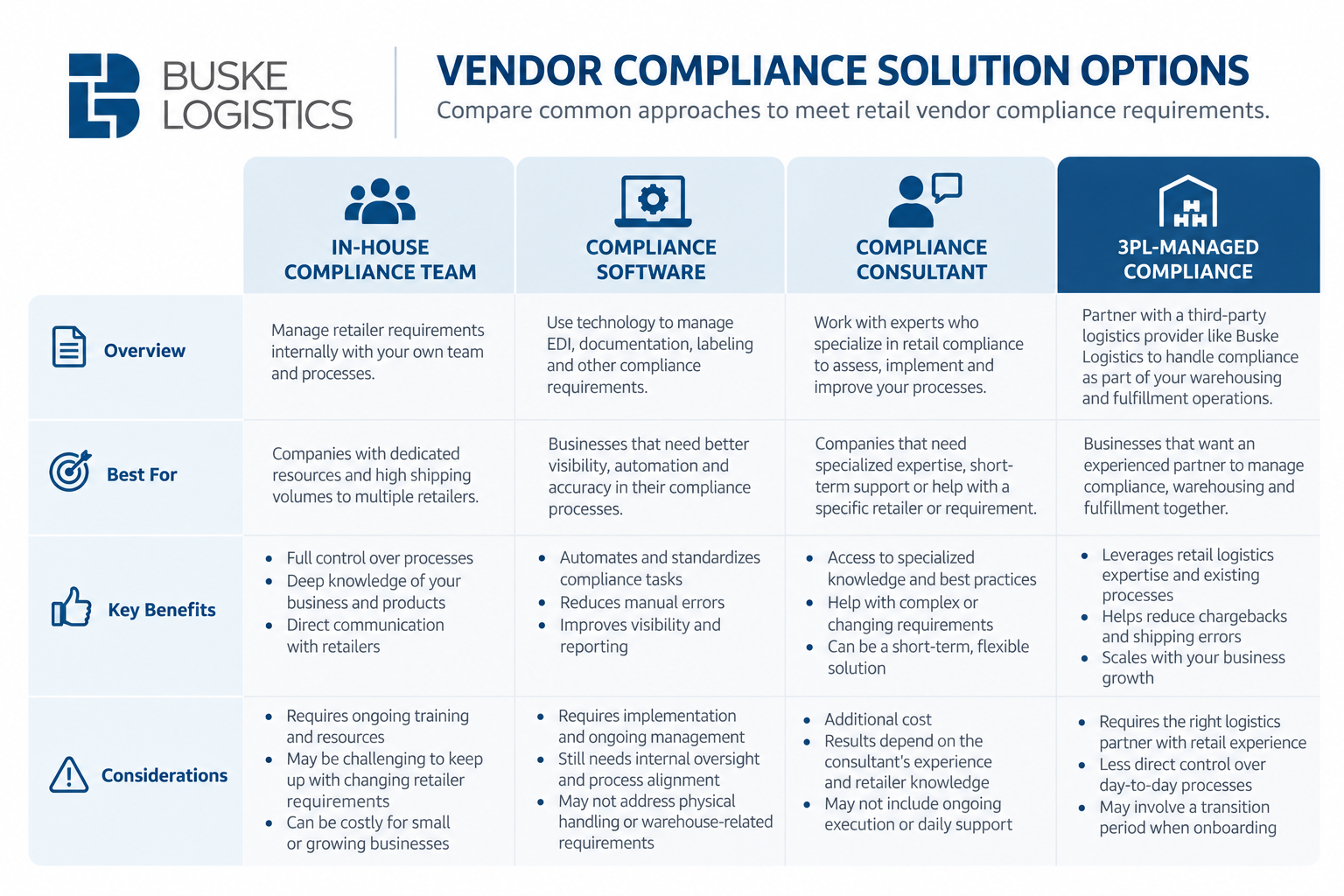
An internal team gives you direct control over retailer requirements, vendor scorecards, chargeback disputes, and compliance procedures.
This approach can work well if you have dedicated staff and established warehouse systems. However, maintaining expertise across multiple retailer programs requires ongoing training and resources.
Compliance software can help automate document exchanges, validate shipment information, and reduce manual errors.
Depending on the platform, these tools may support ASN generation, retailer-specific labeling, and compliance reporting.
Software is particularly useful when you're managing high order volumes, but your team still needs processes to ensure physical shipments match the electronic records.
Consultants provide targeted support for reviewing retailer requirements, investigating chargebacks, improving workflows, and establishing compliance procedures.
This option may suit your business if you need specialized guidance without hiring a full-time compliance team.
However, consultants typically advise on improvements rather than manage daily warehouse and shipping execution.
A retail-experienced third-party logistics (3PL) provider can incorporate retailer requirements directly into fulfillment and transportation workflows.
Depending on the provider's capabilities and service agreement, this may include labeling, packaging, EDI coordination, carrier selection, shipment audits, and compliance reporting.
If your business supplies several retail chains or handles growing order volumes, combining B2B fulfillment with compliance support can reduce the burden on your internal team.
In-House Compliance Team
EDI and Compliance Software
Compliance Consultants
3PL-Managed Compliance
The best vendor compliance solution is the one that fits your operational complexity. Before choosing a provider or platform, evaluate where your compliance errors originate and whether you need better technology, additional expertise, or hands-on fulfillment support.
The best services for retail vendor compliance help you meet retailer requirements consistently, reduce preventable chargebacks, and manage growing order volumes. Before choosing a provider, evaluate how well its capabilities align with the retailers you supply and the compliance challenges your business faces.
Not every logistics provider has experience managing the requirements of major retailers.
Ask whether the provider understands the vendor manuals, shipping procedures, and compliance expectations of your specific retail accounts.
Your provider should be able to support accurate electronic documentation and coordinate information between warehouse, transportation, and retailer systems.
Confirm its ability to manage EDI requirements, generate accurate ASNs, and identify discrepancies before shipments leave.
Evaluate whether the provider can apply different labeling, barcoding, and palletization requirements across your retail accounts.
These capabilities are particularly important when you're shipping multiple SKUs to different distribution centers.
Look for a provider that can help you identify compliance violations, track recurring issues, and access the documentation needed to investigate deductions.
Ask how it reports compliance performance and whether it supports chargeback dispute investigations.
As you add retailers or increase shipment volumes, your logistics operations need to keep pace.
Consider whether the provider's warehouse network, transportation coordination, and retail distribution capabilities align with your current and future needs.
Use this checklist when evaluating potential partners:
The right provider should help you prevent compliance problems, not simply respond after penalties occur. For additional evaluation criteria, explore our guide to the best 3PLs for retailers.
A retail-experienced third-party logistics (3PL) provider helps you manage vendor compliance by incorporating retailer requirements into everyday warehouse and shipping operations. Instead of coordinating separate processes for every retail account, you can work with a logistics partner that supports consistent execution across fulfillment and distribution.
Depending on the provider's capabilities, this support can include:
With more than 100 years of logistics experience, Buske Logistics understands the operational demands of serving retail supply chains. Our retail compliance services help businesses address retailer-specific requirements through coordinated logistics operations.
If you're evaluating outsourced support, explore our guide to the best 3PLs for retailers to understand which capabilities matter most when choosing a logistics partner.
Vendor compliance is the practice of meeting the standards a customer sets for its suppliers. In retail, this includes following requirements for labeling, EDI and ASNs, packaging, routing, and delivery to help ensure shipments are accepted without penalties.
Vendor compliance protects your profit margins by reducing preventable chargebacks, supports stronger vendor scorecards and retailer relationships, and helps shipments move through receiving efficiently. It also makes it easier to expand into new retail accounts and distribution channels.
A vendor compliance manual is a document or online portal that outlines a retailer's requirements for ordering, labeling, packaging, shipping, documentation, and delivery. It may also specify penalties for violations.
Common requirements include EDI and ASN accuracy, carton and pallet labeling, packaging and palletization standards, approved carriers, delivery appointments, on-time, in-full (OTIF) performance, and accurate invoicing. Specific requirements vary by retailer.
Assign clear ownership for each retail account, maintain updated vendor manuals, and convert requirements into warehouse checklists and system rules. Audit shipments before dispatch, track chargebacks by root cause, and train your teams on retailer-specific procedures.
Vendor compliance services help suppliers meet retailer requirements through in-house compliance teams, EDI and compliance software, consultants, or 3PL-managed operations. These services support documentation accuracy, shipment preparation, compliance monitoring, and error prevention.
Retail vendor compliance focuses on meeting a retailer's shipping, documentation, and delivery requirements as a supplier. Vendor risk management involves evaluating and monitoring your own vendors for operational, security, regulatory, or policy-related risks.
Meeting retailer requirements shouldn't mean constantly dealing with chargebacks, shipping errors, and receiving delays. With the right processes and logistics partner, you can protect your margins while strengthening retailer relationships.
Buske Logistics helps businesses navigate complex retail shipping requirements through experienced warehousing and fulfillment support.
Explore our retail compliance services, learn how to prevent retail chargebacks, or contact our team to discuss your vendor compliance needs.

Buske Logistics is a Top 20 Private Warehousing 3PL. Let's build a solution for your supply chain.


