.png)
-p-130x130q80.png)

A routing guide is a set of shipping instructions that tells you how freight must move, which carriers to use, and what requirements must be met before delivery. Retailers issue routing guides to suppliers, while shippers use internal guides to manage carrier selection, transportation costs, and service levels.
If your business ships products to major retailers, following their routing guides is essential. A missed delivery appointment, incorrect pallet label, or unauthorized carrier can lead to chargebacks, rejected shipments, and lower vendor performance scores.
At Buske Logistics, our 100+ years of logistics experience inform how we approach warehouse operations, transportation coordination, and retail compliance.
This guide explains both types of routing guides, what they include, practical shipping examples, and how you can prevent costly compliance violations.
A routing guide is a document or set of instructions specifying how freight must be transported, including approved carriers, shipping methods, delivery requirements, and documentation. Retailers issue routing guides to suppliers, while shippers create internal versions to standardize carrier selection and transportation decisions.
In routing guide shipping, these instructions connect warehouse preparation with transportation execution.
Routing guides may also be called vendor routing guides, shipping guides, or transportation guides.
They typically establish:
Following the correct instructions helps your team avoid shipping errors, delivery delays, and unnecessary compliance costs.
A routing guide in logistics connects order processing, warehouse operations, and transportation by establishing consistent shipping rules. It determines which carriers can move freight, how shipments should be prepared, and which delivery requirements must be followed.
Two types serve different purposes.
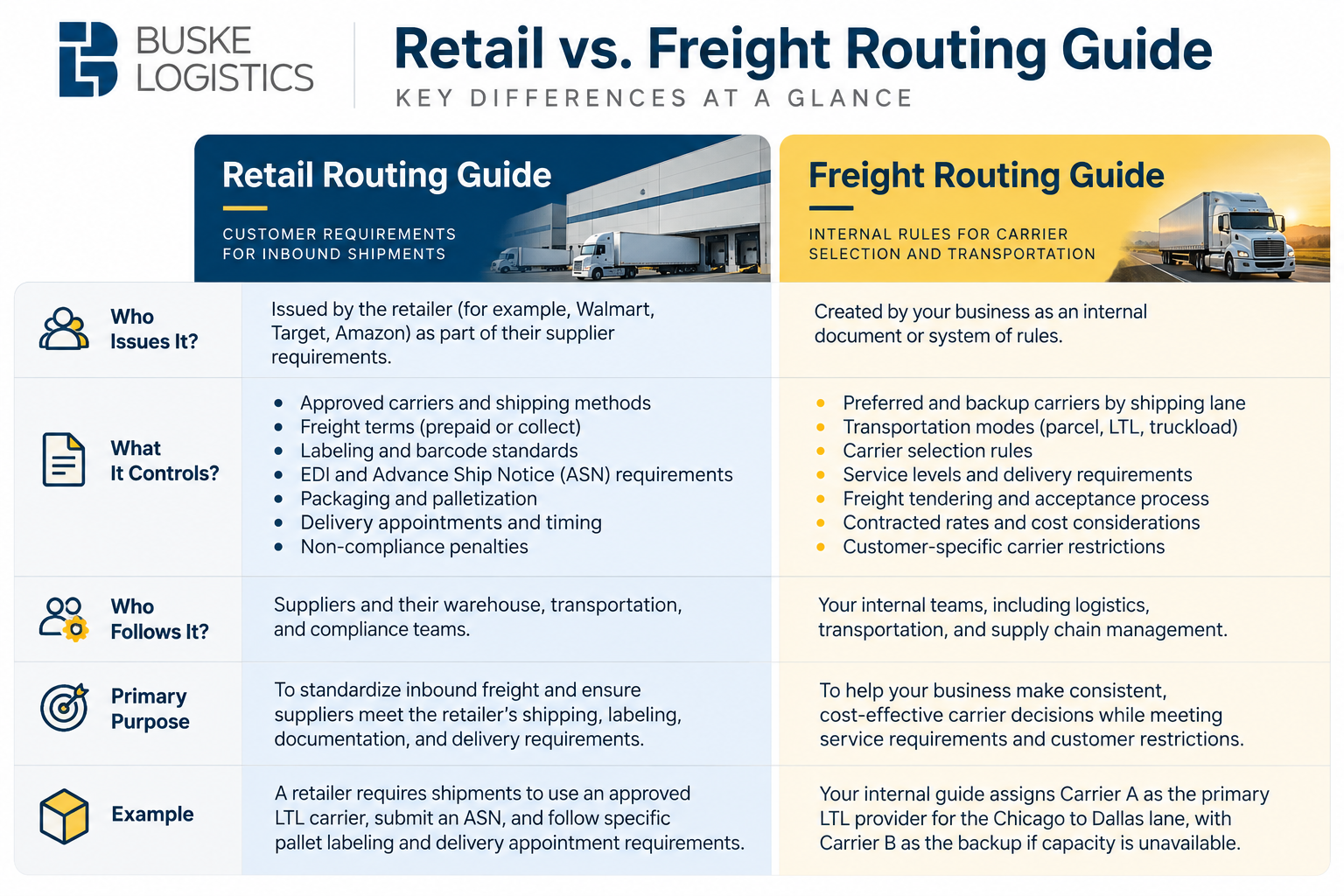
A retailer-issued routing guide establishes the requirements suppliers must follow when delivering products to the retailer's distribution centers or stores.
These requirements may include approved carriers, labeling specifications, electronic shipping documents, pallet standards, and delivery appointments.
Because retailers establish their own requirements, your warehouse and transportation teams must adapt their procedures for each customer.
An internal routing guide helps your business select transportation providers consistently.
It typically identifies preferred carriers by shipping lane, backup carriers, transportation modes, and service requirements.
For example, if your primary LTL carrier cannot accept a shipment, the guide identifies the next approved option.
The distinction is straightforward: Retailer-issued guides establish customer requirements, while internal guides help your business execute transportation decisions.
When shipping to a retailer, your internal guide must account for that customer's restrictions.
Routing guides also differ from retail order routing. Order routing determines which location fulfills an order, while a routing guide determines how the shipment moves after fulfillment.
A retail routing guide outlines the carrier, packaging, documentation, and delivery requirements suppliers must follow when shipping to a retailer. These instructions standardize inbound freight and help retailers manage receiving operations.
If you supply multiple retail chains, you'll need to follow each customer's current requirements rather than assuming one set of rules applies everywhere.
Retailers may specify authorized carriers and whether shipments should move by parcel, LTL, or truckload.Selecting an unauthorized carrier can create a violation even when freight arrives on time.
Freight terms establish who arranges and pays for transportation.
Always verify freight terms against the purchase order and routing instructions before booking.
Retailers may require specific carton labels, pallet identification, barcode formats, and purchase order references. Incorrect or unreadable labels can delay receiving or require additional handling.
Many retailers require Electronic Data Interchange (EDI) transactions and Advance Ship Notices (ASNs).
An ASN communicates shipment details before arrival. Your team must ensure the information matches the physical freight and meets the retailer's transmission deadline.
Requirements may specify case-pack quantities, pallet dimensions, weight limits, stacking patterns, and load-securing methods. These standards help freight move through receiving facilities efficiently.
Retailers may require scheduled delivery appointments, specific receiving windows, and on-time, in-full (OTIF) performance.
Your transportation team must coordinate carrier availability with warehouse readiness and appointment requirements.
Routing guide violations may result in financial deductions, delayed receiving, or lower supplier scorecard ratings.
Repeated mistakes can create significant costs. Learn more about their impact in our guide to retail chargebacks.
Important: Retail routing guides change, and requirements vary by retailer. For example, Walmart's Fulfillment Services Routing Guide outlines labeling, packaging, and shipping requirements for inventory sent to its fulfillment centers. Always consult the current requirements for your specific retailer and shipping program before dispatch.
A freight routing guide is an internal document or system of rules that identifies which carriers should handle shipments based on lane, transportation mode, service level, and cost. It helps your transportation team make consistent carrier-selection decisions.
Unlike a retailer-issued guide, an internal freight routing guide is developed by your business.
Your guide should identify preferred carriers for each shipping lane and approved alternatives when capacity is unavailable. This reduces time spent searching for transportation and helps maintain service consistency.
Carrier assignments should account for:
For shipments moving through retail freight networks, retailer requirements must take priority over internal carrier preferences when they conflict.
A routing guide should establish a clear tendering sequence:
This reduces delays caused by last-minute carrier decisions.
A Transportation Management System (TMS) can apply routing rules automatically, including carrier eligibility, tender sequencing, and service requirements. However, automated decisions still depend on accurate carrier information and current customer restrictions.
Your internal freight routing guide must incorporate each retailer's requirements. Choosing a lower-cost carrier that a retailer has not approved could generate a chargeback that exceeds the transportation savings.
Routing guide examples demonstrate how shipping instructions affect carrier selection, warehouse preparation, and retail compliance. The following scenarios are illustrative and do not represent the actual requirements of any specific retailer.
Suppose your business ships 12 pallets of consumer packaged goods to a retailer's distribution center.
An illustrative routing guide might require:
Your warehouse team prepares the freight and verifies labels, while transportation confirms the carrier and appointment. Before dispatch, your team checks that the ASN matches the purchase order and physical shipment.
Key takeaway: A retail routing guide affects warehouse preparation and documentation, not just transportation.
An internal routing guide may organize carrier preferences as follows:
Lane 1: Chicago, IL → Dallas, TX
Lane 2: Indianapolis, IN → Atlanta, GA
Lane 3: Houston, TX → Memphis, TN
Illustrative carrier assignments only; these are not Buske Logistics carrier arrangements.
If Carrier A rejects a shipment, your team can tender it to Carrier B, provided the customer permits that carrier.
Key takeaway: An internal freight routing guide standardizes carrier selection while preserving customer-specific restrictions.
A supplier books an LTL carrier offering a lower rate without checking the retailer's approved carrier list. The shipment arrives on time, but the retailer identifies the unauthorized carrier and assesses a chargeback under its applicable policy.
The violation could have been prevented by:
Key takeaway: The lowest freight rate does not always produce the lowest total shipping cost.
Routing guide shipping follows a coordinated process from purchase order receipt through warehouse preparation, carrier selection, delivery, and retailer receiving. Each step helps ensure freight meets the customer's requirements.
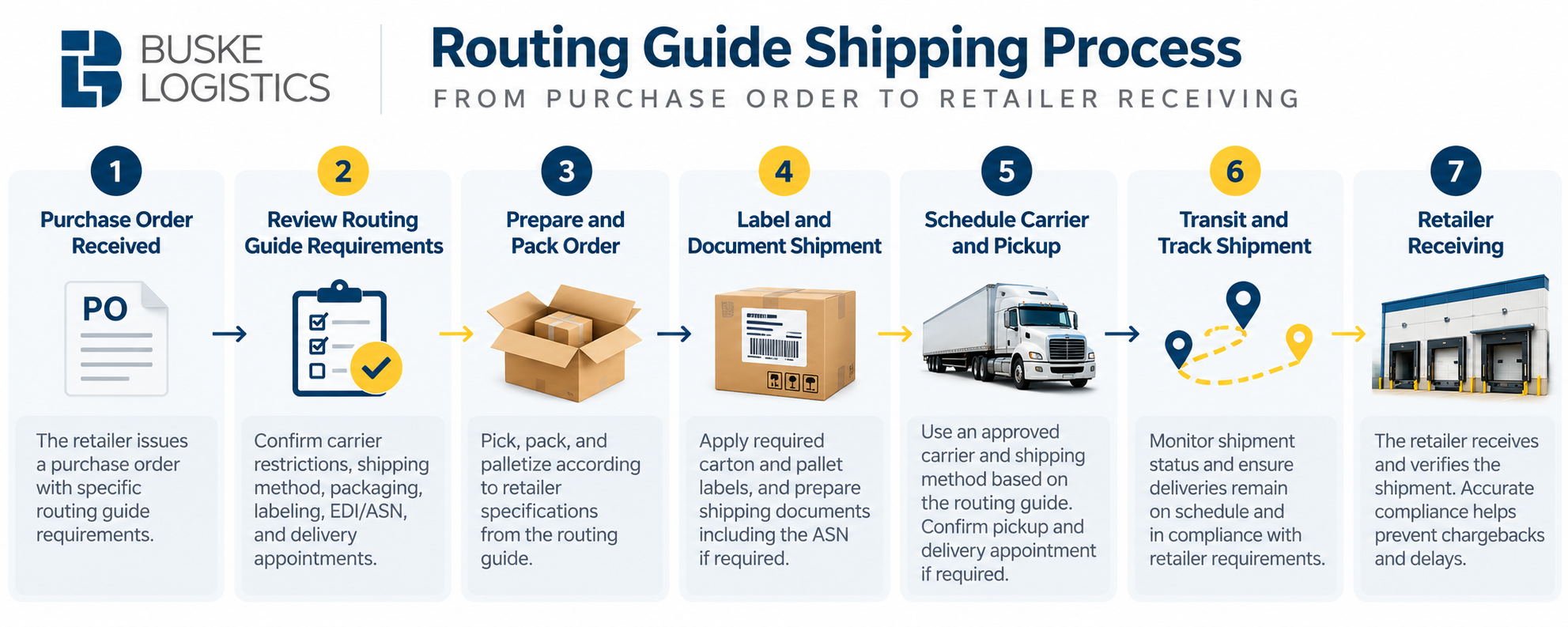
Confirm the current routing instructions, freight terms, destination, shipping dates, and retailer-specific requirements before fulfillment begins.
Choose the appropriate shipping method and verify that the carrier is authorized for the shipment. If your preferred carrier is unavailable, confirm that any replacement is permitted.
Follow the retailer's appointment-booking procedures and confirm the receiving window before dispatch.
Verify quantities, carton labels, barcode placement, pallet dimensions, stacking, and load security against the routing guide.
Transmit required EDI transactions, ASNs, and shipping records according to the retailer's deadlines. Ensure electronic shipment information matches the physical freight.
Tender freight to the approved carrier, confirm pickup, and monitor delivery against the scheduled appointment.
Follow the retailer's procedures if delays require notification or rescheduling.
The retailer may compare the shipment against its purchase order, ASN, labeling requirements, and delivery records. Review any discrepancies or violations so your team can correct recurring problems.
The goal is consistency: Every department should follow the same retailer-specific instructions from order receipt through final delivery.
Routing guide compliance means shipping freight according to a retailer's carrier, transportation, labeling, documentation, packaging, and delivery requirements. Following these instructions helps your business avoid chargebacks, receiving delays, and supplier performance penalties.
Compliance must be built into warehouse and transportation workflows, especially when your business ships to multiple retailers with different requirements.
Frequent violations include:
Many of these errors originate before a shipment leaves the warehouse.
Depending on the retailer's policies, violations may result in:
A shipment can contain the correct products and quantities yet still violate routing requirements because its ASN was late or its carrier was unauthorized.
For more on the financial consequences, see our retail chargebacks guide.
Consistent compliance helps you protect margins, reduce receiving exceptions, and maintain reliable supplier performance.
It also supports broader retail compliance, which includes purchase order accuracy, labeling, delivery performance, and other retailer-specific requirements.
When your teams follow current routing instructions consistently, you reduce preventable errors before they become costly shipping problems.
Maintaining routing guide compliance requires current retailer requirements, standardized warehouse procedures, and regular shipment audits. Rather than relying on your team to remember different shipping rules, build compliance checks into everyday fulfillment and transportation workflows.
Here are six best practices to help you reduce violations and avoid unnecessary chargebacks.
Maintain a centralized copy of each retailer's latest routing guide and assign responsibility for monitoring changes.
When requirements change, update your internal procedures and communicate the revisions to warehouse and transportation teams before affected shipments are processed.
Incorporate retailer-specific requirements into picking, packing, labeling, and shipping procedures.
For example, your team should know which pallet labels, packaging standards, and shipping documents apply to each customer before preparing an order.
This reduces the risk of discovering compliance errors after freight has been loaded.
Where possible, use warehouse and transportation systems to automate repetitive compliance tasks.
Depending on your systems, automation can help:
Automation reduces manual work, but your team must still maintain accurate retailer requirements and review exceptions.
Conduct a final outbound compliance check before releasing freight to the carrier.
Verify that:
Catching discrepancies before dispatch is generally less costly than resolving them after delivery.
Different retailers may have different requirements for the same product or shipment type.
Provide customer-specific training for warehouse associates, shipping coordinators, and transportation teams. Use clear checklists and documented procedures so employees can reference requirements during daily operations.
Review chargebacks, receiving exceptions, and supplier scorecard results regularly.
Identify recurring issues and determine whether they originate from outdated instructions, incorrect system settings, insufficient training, or process gaps.
The goal is to prevent repeat violations, not simply resolve individual chargebacks. By tracking the causes of compliance failures, you can improve shipment accuracy and reduce unnecessary operating costs over time.
A third-party logistics (3PL) provider helps your business maintain routing guide compliance by coordinating retailer-specific requirements across warehousing, fulfillment, documentation, and transportation. This reduces the burden on your internal team while helping prevent costly shipping errors.
If you're supplying multiple retailers, working with a 3PL experienced in retail logistics can help you manage:
With more than 100 years of logistics experience, Buske Logistics understands how warehouse execution and transportation coordination affect retail compliance.
Our B2B fulfillment services and expertise support businesses managing complex shipping requirements, while our retail compliance solutions help align warehouse operations with retailer expectations.
If you're evaluating logistics partners, our guide to the best 3PLs for retailers explains what to consider when selecting a provider for your retail supply chain.
A routing guide is a set of shipping instructions specifying how freight must move, including approved carriers, transportation methods, delivery requirements, and documentation. Retailers issue routing guides to suppliers, while shippers use internal versions to standardize carrier selection.
A retail routing guide is a document retailers provide to suppliers outlining requirements for shipping to their stores or distribution centers. It typically covers approved carriers, packaging, labeling, EDI and ASN requirements, and delivery appointments.
A freight routing guide is an internal set of transportation rules that helps your business select carriers for specific shipments. It typically identifies preferred and backup carriers by shipping lane, transportation mode, and service requirements.
Failing to follow a routing guide can result in chargebacks, delayed or refused deliveries, and lower supplier scorecard ratings. The specific penalties depend on the retailer's policies and the type of violation.
A routing guide determines how a shipment must be transported, documented, and delivered. Order routing determines which warehouse, store, or fulfillment center should fulfill an order. Both support logistics execution but address different operational decisions.
Keep retailer routing guides updated, incorporate requirements into warehouse and transportation workflows, and automate EDI, ASN, and carrier-selection processes where possible. Regular outbound audits, employee training, and violation tracking also help prevent recurring compliance issues.
A well-managed routing guide helps you control freight costs, maintain consistent shipping procedures, and avoid preventable retail compliance penalties. Whether you're following retailer-issued requirements or managing an internal carrier-selection process, accuracy at every stage matters.
Buske Logistics helps businesses coordinate warehousing, fulfillment, and transportation around complex retail requirements. Explore our retail compliance guide and retail chargebacks guide, or contact our logistics team to discuss your shipping and compliance needs.

Buske Logistics is a Top 20 Private Warehousing 3PL. Let's build a solution for your supply chain.