.png)
-p-130x130q80.png)
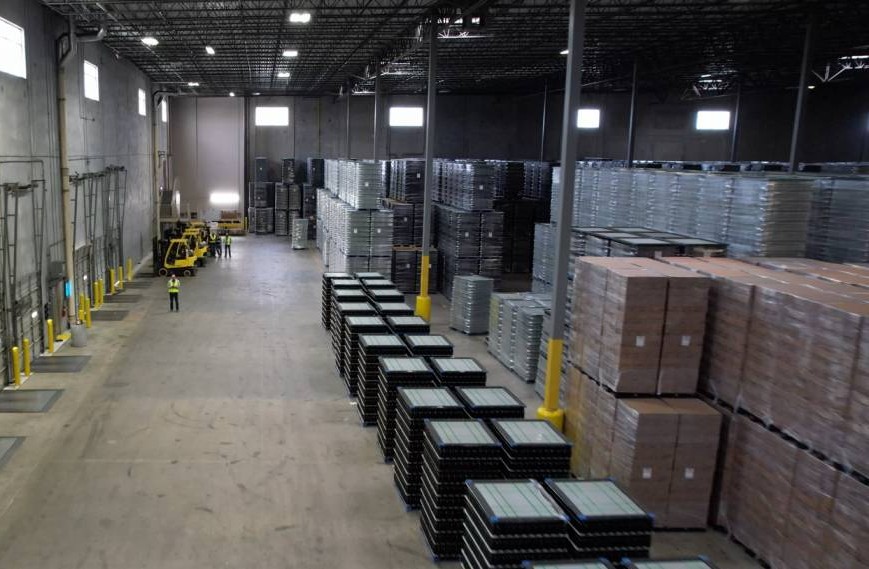
Warehouse distribution costs encompass all expenses associated with receiving, storing, managing, and shipping inventory through a distribution center. Total warehouse distribution costs typically range from 3–8% of revenue for well-managed operations and 8–15%+ for inefficient ones. Key costs include facility, labor, technology, transportation, and inventory carrying costs. Understanding these categories helps businesses accurately assess and reduce their total distribution costs.
Before diving into individual cost categories, understand the fundamental structure: warehouse distribution costs divide into fixed costs (facility lease, technology licenses, management salaries incurred regardless of volume) and variable costs (labor, outbound shipping, packaging materials, scaling with activity).
The ratio of fixed to variable costs is one of the most consequential aspects of the private DC vs. 3PL decision, as private DCs are heavily fixed cost while 3PL arrangements convert most costs to variable.
Facility costs are typically the second-largest cost category in private DC operations (behind labor), representing 15–25% of total operating cost. For 3PL arrangements, facility cost is embedded in the per-unit pricing rather than appearing as a separate line item.
Labor is the single largest cost in most distribution operations, representing 45–60% of total DC operating cost. Understanding the full labor cost burden, not just the hourly wage, is critical for accurate cost modeling.
The 3PL Labor Advantage: 3PL operators typically manage labor 20–30% more efficiently than comparable private DC operations for three structural reasons: workforce flexibility (ability to flex headcount across multiple clients and facilities without layoffs during slow periods), management expertise (career logistics operations managers versus self-built teams), and technology leverage (WMS labor management tools that optimize task assignment, measure productivity against engineered standards, and identify inefficiencies in real time).
Technology is the most frequently underestimated cost in private DC build models because it involves both a substantial upfront capital investment and significant ongoing operational costs that persist throughout the system's life.
Enterprise WMS (Manhattan, Blue Yonder, SAP EWM): $200K–$5M implementation + $100K–$500K/year in licensing. Mid-market WMS (Körber, Infor): $50K–$200K implementation + $30K–$150K/year. Cloud-based SaaS WMS can reduce upfront costs significantly but require careful evaluation of integration capability.
Carrier selection, rate shopping, load planning, freight audit. Enterprise TMS (Oracle TM, MercuryGate): $100K–$500K/year. Mid-market: $30K–$100K/year. 3PL partnerships include TMS capability as part of the service, eliminating this line item entirely.
Handheld barcode scanners: $500–$1,500 each; replace every 3–5 years. Label printers: $400–$2,000 each. Forklift-mounted terminals cost $1,500–$4,000 each. A 100-person DC may require 80–120 scanning devices, resulting in a total hardware investment of $50K–$150K, plus ongoing replacement costs.
Network infrastructure (WiFi access points, switches, servers or cloud infrastructure), cybersecurity systems, IT support staff or managed services. Often overlooked in initial DC cost models but essential for WMS and integration uptime in high-velocity operations.
Transportation is often the largest total cost in a supply chain, frequently exceeding warehouse operating costs, and breaks into two distinct streams in a distribution operation:
Inbound freight brings inventory from suppliers, manufacturers, or ports into the DC. Costs depend on: origin geography (domestic vs. import), shipment size (FTL economics apply above 15,000 lbs; LTL for smaller inbound), and carrier relationships. Well-managed inbound programs use consolidation programs (aggregating multiple supplier shipments into full truckloads) and import container optimization to achieve the most favorable per-unit inbound rates. See Buske's freight shipping guide for complete inbound freight optimization strategies.
Outbound shipping is typically the largest single cost in a direct-to-consumer distribution model. Key benchmarks:
The visible costs of warehouse distribution are easy to budget. The hidden costs are what make most private DC business cases look better on paper than in practice:
Major retailers (Walmart, Target, Costco, Amazon Vendor Central) impose financial penalties called chargebacks for shipments that don't comply with their specific labeling, routing, EDI, and packaging requirements. Chargeback rates for inexperienced shippers typically run 2–5% of invoice value. At $10M in retail sales, that's $200K–$500K annually often invisible in budget models that assume compliance but don't build in the operational cost of achieving it. Professional 3PL distribution operations with dedicated retail compliance capabilities systematically eliminate this cost.
Inventory is an asset that must be financed. At a 10% cost of capital and $5M of average inventory, the capital carrying cost is $500K/year before adding storage, insurance, and obsolescence costs. Most distribution cost models account for warehouse storage costs but omit the capital carrying cost entirely, dramatically underestimating the true cost of holding inventory. Optimizing inventory turns reduces carrying cost proportionally.
What does it cost when you miss an OTIF commitment to a major retail customer? When an e-commerce order arrives damaged? When a stockout loses a sale? These costs such as customer credits, emergency expediting, lost sales, account deductions, and long-term customer value erosion are real and substantial but rarely appear in distribution cost models. Operating a distribution partner with 99.5%+ accuracy and 98%+ OTIF performance is not just a service goal, it is a financial protection against chargebacks, credits, and lost revenue.
Running a private DC requires significant internal management bandwidth, including a VP of Operations or Supply Chain, a DC management team, HR support, IT support, and executive attention on operational issues. This management overhead cost is real but often omitted from private DC cost models. For most businesses, redirecting that management bandwidth from running a warehouse to growing the core business generates far more value than any margin from vertical integration of logistics.
3PL distribution pricing is structured around the specific activities performed on a client's behalf, a model that ensures costs scale with value delivered and volume processed. Here is a realistic breakdown of how 3PL distribution pricing works:
Benchmarking total 3PL distribution cost against private DC total cost of ownership almost always shows the 3PL to be cost-competitive or favorable for businesses below 500,000 sq ft of consistent annual utilization and dramatically more flexible, faster to deploy, and less capital-intensive at every scale.
A private distribution center's annual operating cost depends heavily on size and location, but a typical 200,000 sq ft regional DC costs $3M–$8M per year to operate, including: facility (lease, utilities, maintenance): $1M–$2.5M; labor (direct and indirect): $1.5M–$4M; technology (WMS, TMS, hardware support): $200K–$500K; and overhead (management, insurance, compliance): $300K–$600K. On a per order or per unit basis, total costs depend on order volume. Fixed costs are spread across more orders at higher throughput, typically resulting in a cost of $3–$8 per order at 1,000 or more orders per day.
3PL distribution cost per order for standard e-commerce (1–3 line items, standard packaging) typically ranges from $2–$8 per order for pick-pack-ship services, plus storage costs ($12–$30/pallet/month) and outbound shipping (at contract carrier rates). Total landed cost per order including storage, handling, and shipping typically runs $6–$20 for domestic parcel, depending on order complexity, parcel weight, and destination zone. Complex multi-line orders, kitted products, or special handling requirements increase per-order costs proportionally.
Industrial warehouse lease rates in the U.S. range from approximately $4–$7/sq ft/year in secondary Midwest and Southeast markets to $12–$18/sq ft/year in major coastal logistics corridors (Inland Empire CA, Northern NJ, Southern Florida). Triple-net leases are standard, with tenants also paying property taxes, insurance, and maintenance on top of base rent. Cold storage commands an additional $4–$12/sq ft premium for refrigeration infrastructure and operating costs. These rates have risen 40–60% in major markets over 2020–2025 as e-commerce drove unprecedented demand for industrial space.
For most businesses below 500,000 sq ft of consistent annual utilization, 3PL distribution is cost-competitive with or cheaper than private DC on a total cost of ownership basis when all costs are included: facility (lease/ownership, maintenance, utilities), labor (wages, benefits, management, turnover), technology (WMS, TMS, hardware), overhead (HR, compliance, IT), and capital cost of the facility investment. 3PL partners also eliminate the hidden costs of service failures (chargebacks, errors) through professional-grade operations. Private DCs achieve lower per-unit costs at very high, stable volumes typically above 200,000–500,000 sq ft of consistent utilization.
Retail compliance chargebacks are financial deductions imposed by major retailers (Walmart, Target, Costco, Amazon Vendor Central) when supplier shipments don't comply with their specific labeling, EDI, routing, or packaging requirements. Chargeback rates for inexperienced shippers typically run 2–5% of invoice value. At $10M in retail revenue, that can result in $200K–$500K in annual preventable costs. 3PL distribution partners with dedicated retail compliance expertise and retail specific operational workflows can help reduce chargebacks through accurate EDI execution, compliant labeling, and routing guide adherence.

Buske Logistics is a Top 20 Private Warehousing 3PL. Let's build a solution for your supply chain.