


An advanced shipping notice (ASN) is an electronic notification that tells retailers what you're shipping, how it's packed, and when it's expected to arrive. For suppliers working with major retailers, sending accurate shipment information is an essential part of meeting compliance requirements and keeping deliveries on track.
Late, missing, or inaccurate ASNs can lead to receiving delays, inventory discrepancies, and costly retail chargebacks. That's why your ASN needs to match what's physically shipped and meet each retailer's requirements.
With over 100 years of logistics experience, Buske Logistics understands the importance of accurate shipment data in maintaining retail compliance.
This guide covers what an ASN contains, how EDI 856 works, the shipment notification process, key benefits, common errors, and best practices to help you improve shipping accuracy.
An advanced shipping notice (ASN) is an electronic notification a supplier sends to a customer before a shipment arrives. It provides details about the products being shipped, how they're packed, and when delivery is expected. This allows the receiving warehouse to prepare for the shipment and verify its contents against the original purchase order.
Also called an advance ship notice or advance shipping notice, an ASN gives retailers visibility into incoming inventory before it reaches their distribution centers.
Major retailers and many B2B buyers require ASNs as part of their vendor compliance programs. For your business, this means sending accurate shipment information in the retailer's required format and within its specified timeframe.
An ASN isn't simply a shipping confirmation. It's a key document that connects your warehouse operations with your customer's receiving and inventory management processes.
An advanced shipping notice contains shipment, order, packaging, and product information that helps retailers identify and verify incoming deliveries. While specific requirements vary by retailer, most ASNs include five key types of information.
The purchase order (PO) number and shipment identifier connect the delivery to the retailer's original order, making it easier to track and reconcile shipments.
Ship-from and ship-to addresses, along with carrier information, identify where the shipment originated, where it's going, and who is transporting it.
Shipping dates, expected delivery dates, bill of lading (BOL) or tracking numbers, and shipment weight help receiving teams plan for incoming freight.
Carton and pallet identifiers show how products are organized within the shipment. These identifiers must match the physical shipping labels so retailers can scan and verify the delivery accurately.
Product identifiers, such as SKUs or UPCs, and shipped quantities tell the retailer exactly what's arriving. Some retailers also require lot numbers or serial numbers for additional traceability.
Important: Always check your retailer's current vendor compliance manual and routing guide before preparing an ASN. Required fields, labeling specifications, and submission rules can differ between trading partners.
An EDI advanced shipping notice is commonly transmitted using the EDI 856 transaction set, a standardized electronic document that communicates shipment details between trading partners.
Electronic Data Interchange (EDI) allows businesses to exchange standardized documents directly between their systems, reducing the need for manual data entry.
Under the ANSI X12 standard, the EDI 856, officially called the Ship Notice/Manifest, provides a structured format for sending ASN information. International trading partners using EDIFACT may instead use the DESADV (Despatch Advice) message.
According to the X12 standards organization, the 856 communicates shipment contents and related details to help receiving organizations process incoming goods.
An EDI 856 uses a hierarchical structure to organize shipment information, commonly including:
Retailers publish their own EDI implementation guides specifying how these levels and data fields must be organized.
Once generated, the EDI 856 is transmitted through an EDI network or direct connection. The receiving system typically returns an EDI 997 functional acknowledgment, confirming receipt of the document at the EDI processing level.
However, a 997 acknowledgment doesn't necessarily mean the ASN passed every retailer-specific business validation. Your team should also monitor rejected transactions and other compliance errors to ensure the shipment information was accepted.
The difference between an advanced shipping notice and EDI 856 is that the ASN is the shipment notification itself, while EDI 856 is a standardized electronic format used to transmit that information.
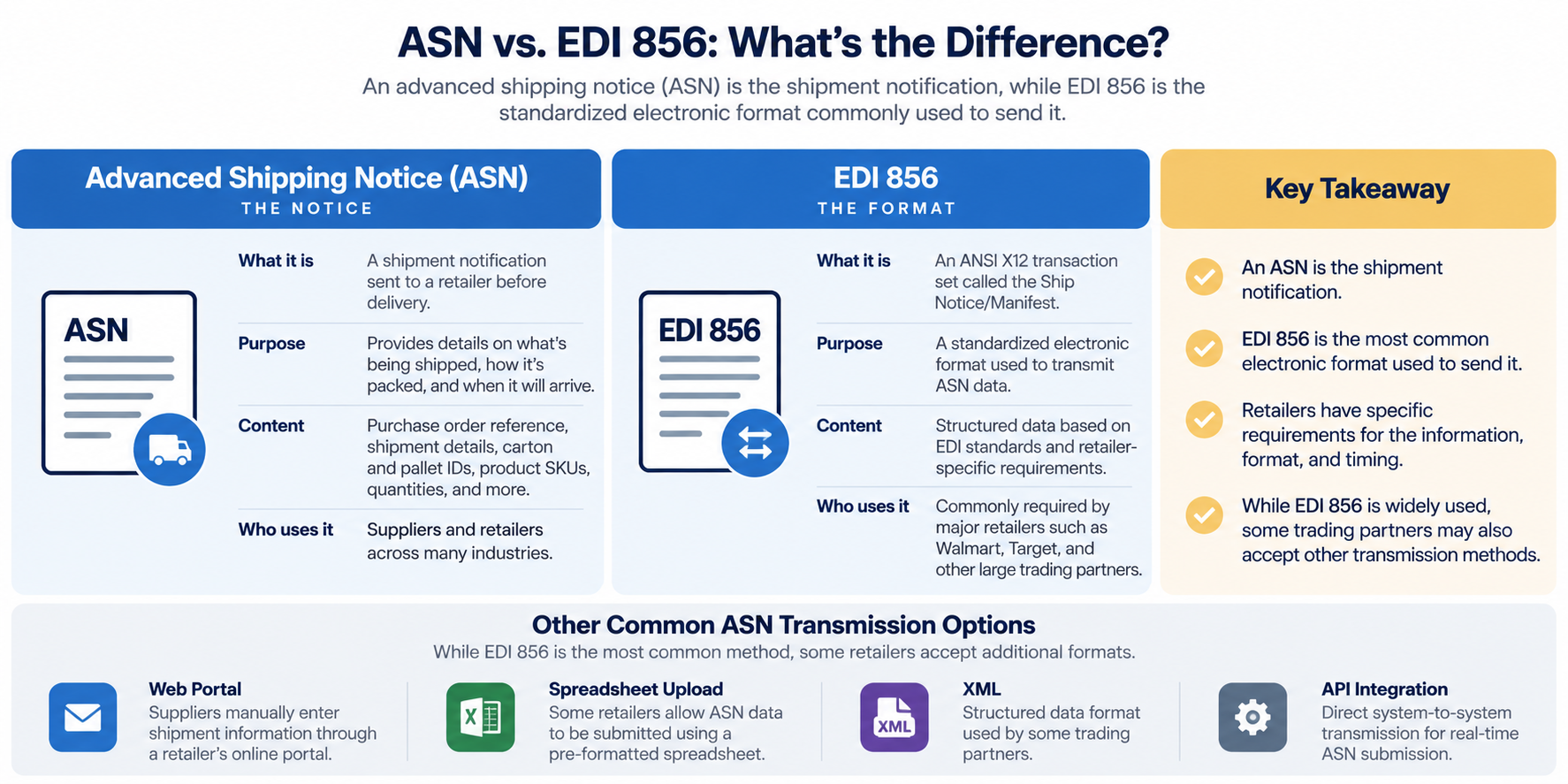
Although the terms are often used interchangeably, they serve different purposes within your shipping and receiving process.
Some trading partners accept ASNs through supplier portals, spreadsheets, email, or APIs. However, major retailers commonly require an EDI 856 that follows their specific implementation guidelines.
For your business, sending shipment information isn't enough if the retailer requires a particular EDI format. You must also ensure the document meets its data, structure, and transmission requirements.
Understanding this distinction helps your warehouse, IT, and compliance teams work together to submit accurate ASNs and avoid preventable receiving issues.
The advanced shipping notice process flow follows a series of steps that connect purchase order processing, warehouse fulfillment, shipment notification, and retailer receiving. Each step helps ensure the information in your ASN accurately reflects the products being delivered.
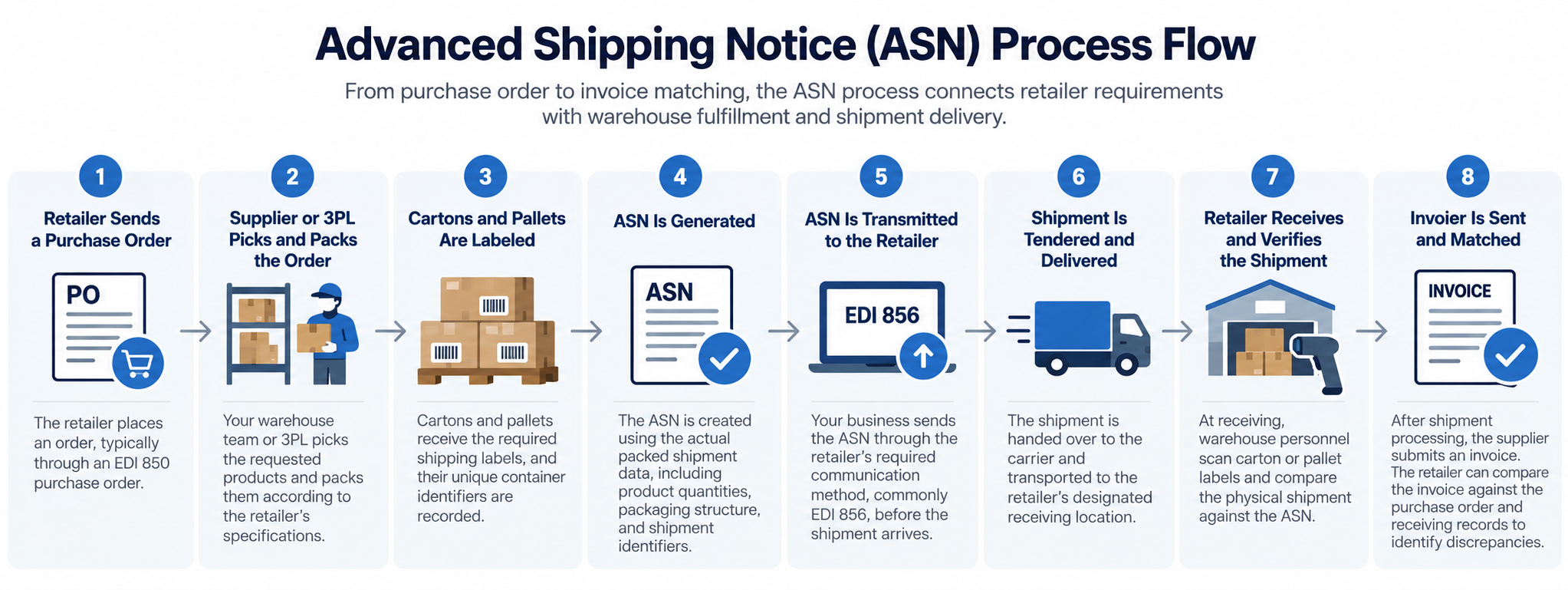
The process begins when a retailer places an order, typically through an EDI 850 purchase order. This document identifies the products, quantities, and delivery requirements your business must fulfill.
Your warehouse team or third-party logistics (3PL) provider picks the requested products and packs them according to the retailer's specifications. Accurate picking and packing are essential for reliable B2B fulfillment.
Once packed, cartons and pallets receive the required shipping labels. Their unique container identifiers are recorded so the ASN can reference the exact physical packages.
The ASN is created using the actual packed shipment data, including product quantities, packaging structure, and shipment identifiers.
The ASN must match what's physically on the truck, which is why it should be generated from confirmed packing and labeling information rather than the original purchase order alone.
Your business sends the ASN through the retailer's required communication method, commonly EDI 856. Submission must follow the retailer's timing rules, generally before the shipment arrives.
The shipment is handed over to the carrier and transported to the retailer's designated receiving location.
At receiving, warehouse personnel scan carton or pallet labels and compare the physical shipment against the ASN. Matching information helps streamline receiving and inventory updates.
After shipment processing, the supplier submits an invoice. The retailer can compare the invoice against the purchase order and receiving records to identify discrepancies.
A coordinated ASN process supports more efficient retail fulfillment by connecting warehouse execution with the retailer's receiving requirements.
The benefits of advanced shipping notices include faster receiving, improved shipment visibility, fewer inventory discrepancies, and reduced compliance risks. When your ASN accurately reflects what's being shipped, both your business and the retailer can manage deliveries more efficiently.
Accurate ASNs allow retailers to scan carton and pallet labels and verify incoming products against shipment records. This reduces manual checks and helps move inventory through receiving more efficiently.
Knowing what's arriving and when helps retailers schedule dock appointments, allocate warehouse staff, and prepare space for incoming products.
An ASN provides a documented record of shipment contents before delivery. When quantities, product identifiers, and packaging details match the physical shipment, it's easier to identify and resolve discrepancies.
Late, missing, or inaccurate ASNs can trigger penalties under a retailer's vendor compliance program. Sending complete, accurate notices within the required timeframe helps reduce avoidable retail chargebacks.
ASNs give retailers advance visibility into incoming stock, supporting inventory planning and more accurate receiving records. For suppliers, consistent ASN accuracy also improves shipment tracking and helps identify fulfillment issues before they become recurring problems.
Ultimately, reliable ASNs support stronger retailer relationships by making shipments easier to receive, verify, and process.
An advanced shipping notice example shows how shipment, packaging, and product information is organized so retailers can identify and verify incoming deliveries.
The following fictional example illustrates a supplier shipping 100 units of a product to a retail distribution center.
Note: This is a simplified, fictional example for illustration only. It is not an actual EDI 856 document or a retailer-specific ASN format.
Before the shipment arrives, the retailer receives the ASN containing the purchase order reference, expected delivery date, and shipment details.
When the delivery reaches the distribution center, the receiving team can scan the carton or pallet identifiers and compare them with the ASN. If the product identifiers and quantities match, the retailer can process the shipment with fewer manual checks.
For your business, the important takeaway is that every ASN should reflect the actual shipment, including how products are packed and labeled. Even when the purchase order is correct, differences between the ASN and physical delivery can create receiving discrepancies.
Common ASN errors include late submissions, inaccurate shipment details, mismatched labels, incorrect order references, and formatting issues. These mistakes can delay receiving, disrupt inventory processing, and result in retailer compliance penalties.
Sending an ASN after the shipment arrives, or failing to send one entirely, can prevent retailers from preparing for receiving. Always follow your trading partner's submission deadlines.
Differences between the ASN and the physical shipment, such as incorrect quantities, missing items, or inaccurate packaging details, can create receiving discrepancies.
Carton and pallet identifiers in the ASN must match the corresponding physical shipping labels. Mismatched identifiers can interfere with scanning and automated receiving.
An incorrect purchase order number, shipment identifier, or ship-to location can prevent the retailer from matching the delivery to its records.
Retailers have specific EDI implementation requirements. Missing mandatory fields, incorrect data structures, or invalid values can cause an EDI 856 to be rejected.
For example, Walmart's official Supply Chain Packaging Guide provides supplier guidance related to packaging, labeling, and shipment information. Requirements differ by retailer, so always consult your trading partner's current documentation.
These errors can affect your broader vendor compliance performance and increase the risk of retail chargebacks. Regularly reviewing ASN errors helps your team identify recurring problems before they affect additional shipments.
Following advanced shipping notice best practices helps your business improve shipment accuracy, meet retailer requirements, and reduce avoidable compliance errors. The key is to connect ASN preparation with your actual warehouse operations.
Create each ASN after products have been picked, packed, and labeled. Use confirmed shipment quantities and container identifiers rather than relying solely on the original purchase order.
Check your ASN against the retailer's current EDI implementation guide, including required fields, packaging hierarchy, and labeling specifications.
Where possible, integrate your warehouse management system (WMS) with your EDI platform to reduce manual entry and support timely transmission. Configure workflows around each retailer's submission deadlines.
Track EDI acknowledgments, including 997 responses, and investigate rejected transactions promptly. Remember that a technical acknowledgment doesn't necessarily confirm full retailer compliance.
Review trading-partner mappings whenever retailers update their requirements. Outdated configurations can lead to missing information or rejected documents.
When onboarding a new retailer, test ASN generation, labeling, and transmission against its specifications before processing live shipments.
Monitor submission timeliness, rejected ASNs, shipment discrepancies, and related chargebacks. Use these findings to identify recurring issues and improve your processes.
Consistent validation, testing, and performance monitoring help make ASN accuracy part of your daily warehouse operations rather than a last-minute compliance task.
A retail-experienced third-party logistics (3PL) provider helps manage advanced shipping notices by connecting warehouse operations, shipment labeling, and EDI transmission. This helps ensure the ASN reflects what actually ships and meets the retailer's submission requirements.
When your 3PL integrates its warehouse management system (WMS) with EDI processes, it can support:
For brands managing multiple retail accounts, these capabilities can reduce manual coordination between warehouse, IT, and compliance teams.
When evaluating providers, consider their retail fulfillment experience, EDI capabilities, and ability to support your customers' specific requirements. Our guide to the best 3PLs for retailers explains what to look for.
Buske Logistics provides retail-focused logistics solutions designed to support accurate fulfillment and retailer requirements. Explore our retail compliance services to learn how we can help strengthen your shipping operations.
An advanced shipping notice (ASN) is an electronic notification a supplier sends to a customer before a shipment arrives. It details what's being shipped, how it's packed, and when delivery is expected, allowing the receiver to prepare and verify the shipment.
The EDI 856 is the ANSI X12 transaction set called the Ship Notice/Manifest. It's the standardized electronic format commonly used to send advanced shipping notices between trading partners.
An ASN is the shipment notification itself, while EDI 856 is a standardized electronic format used to transmit it. Major retailers commonly require suppliers to submit ASNs as EDI 856 documents that follow their specifications.
An ASN typically includes purchase order references, shipping locations, carrier information, shipment dates, carton and pallet identifiers, product SKUs, and quantities. Exact requirements vary by retailer.
An ASN is generally sent after an order has been packed and labeled but before the shipment arrives. Some retailers have stricter submission deadlines, so always follow your trading partner's current requirements.
Late, missing, or inaccurate ASNs can cause receiving delays, shipment holds or rejections, inventory discrepancies, and retailer chargebacks. The consequences depend on the retailer's compliance program.
An ASN is sent electronically before delivery to provide advance shipment information. A packing slip lists the contents of a shipment, while a bill of lading documents the transportation of goods. These documents serve different purposes but help support shipment verification.
Accurate advanced shipping notices help your business streamline receiving, improve shipment visibility, and reduce costly compliance errors. Meeting retailer requirements starts with reliable warehouse processes and shipment data that reflects what's actually delivered.
With over 100 years of logistics experience, Buske Logistics helps brands navigate complex retail supply chains through tailored fulfillment and distribution solutions.
Explore our retail compliance and vendor compliance resources, or contact Buske Logistics to discuss your retail fulfillment needs.

Buske Logistics is a Top 20 Private Warehousing 3PL. Let's build a solution for your supply chain.


