


For consumer packaged goods (CPG) brands, CPG retail compliance can directly affect your profit margins and retailer relationships. When you're managing fast-moving SKUs, frequent replenishment orders, and multiple retail accounts, even small shipping errors can quickly become costly.
A mislabeled pallet, missed delivery appointment, or inaccurate advance shipping notice (ASN) might seem minor. But when the same mistake happens across hundreds of shipments, retailer chargebacks add up. Poor compliance performance can also weaken your retailer scorecards, potentially affecting shelf placement and future opportunities.
With thin per-unit margins and demanding replenishment schedules, your business needs more than a process for correcting errors after they happen. You need a way to prevent them before shipments leave the warehouse.
This guide explores the compliance challenges unique to CPG brands, why retailers flag certain shipments, the most common causes of deductions, and how an experienced 3PL can help protect your margins through more accurate fulfillment.
Retail compliance for CPG brands refers to the retailer-specific shipping and fulfillment requirements that consumer packaged goods suppliers must follow when delivering products to grocery chains, big-box stores, club retailers, and other retail accounts. These requirements cover routing instructions, shipping labels, barcodes, pallet configurations, advance shipping notices (ASNs), delivery windows, and order accuracy.
Unlike other industries, CPG brands often ship high volumes of fast-moving, relatively low-priced products on recurring replenishment schedules. This means your compliance processes must work consistently across every shipment, not just when onboarding a new retailer.
For example, if you're shipping beverages to a grocery distribution center every week, a recurring pallet-labeling error could affect dozens of deliveries before your team identifies the problem.
Important distinction: CPG compliance can also refer to regulatory requirements, such as FDA rules, food safety standards, and product labeling laws. This article focuses specifically on meeting retailers' operational and shipping requirements, not regulatory compliance.
For a broader explanation of retailer requirements across industries, see our retail compliance guide.
CPG brands face greater retail compliance pressure because they manage frequent replenishment orders, fast-moving inventory, promotional shipments, and different requirements across multiple retail channels. In CPG retail logistics, even a small operational mistake can affect dozens of shipments and lead to recurring deductions.
Unlike products shipped occasionally, consumer packaged goods often require weekly or even more frequent replenishment.
If your warehouse repeatedly uses an incorrect pallet configuration or shipping label, the same violation can appear across multiple purchase orders before it's corrected.
Fast-selling products can quickly run out of stock, especially when demand increases unexpectedly.
When inventory isn't available to fulfill a retailer's order, your business risks short shipments, lower fill rates, and on-time, in-full (OTIF) performance issues.
Retail promotions often have strict delivery schedules because products must arrive before advertised launch dates.
Promotional displays, seasonal packaging, and mixed-SKU pallets may also require different configurations from standard replenishment shipments.
For food, beverages, and other date-sensitive CPG products, retailers may specify minimum remaining shelf life upon delivery.
Shipping products with insufficient remaining shelf life can result in rejected inventory or compliance deductions. Requirements vary by retailer and product category.
When retail, club, and direct-to-consumer (DTC) orders draw from the same inventory pool, allocation becomes more complicated.
Without clear inventory priorities, a sudden increase in online demand could leave insufficient stock for a scheduled retail replenishment order.

Different retail channels create different operational challenges for CPG suppliers.
Note: These are typical industry patterns. Always verify requirements against each retailer's current supplier guidelines.
If your brand supplies major retail chains, understanding these differences is essential. Explore how 3PL support for big-box retailers and logistics solutions for national supermarket chains address the operational needs of different retail channels.
Retail routing guide compliance is essential for CPG brands because retailers have specific requirements for carriers, freight terms, delivery schedules, and warehouse appointments. Failing to follow these instructions can lead to shipment delays, compliance deductions, and disruptions to retail replenishment.
A routing guide is a set of shipping instructions issued by a retailer to its suppliers. It outlines how shipments should be transported, documented, and delivered to designated distribution centers.
For a detailed explanation, see our retailer routing guide resource.
Retailers may require you to use approved carriers, follow specific transportation methods, or comply with designated freight terms.
For CPG brands shipping recurring orders to multiple distribution centers, selecting the wrong carrier or applying incorrect freight terms can create repeated violations.
Many retailers require shipments to arrive within specified delivery windows. Arriving too early or too late may result in penalties, depending on the retailer's requirements.
This is particularly important for perishable products and promotional inventory, where delayed shipments can affect product availability and scheduled retail campaigns.
Retail distribution centers often require carriers to schedule delivery appointments in advance.
When you're coordinating frequent CPG replenishment shipments across several retailers, managing appointments becomes an ongoing operational responsibility. Missed bookings, carrier delays, or scheduling errors can disrupt receiving and affect your retailer scorecards.
Illustrative example: Your brand is shipping promotional display pallets for an upcoming grocery campaign. The carrier misses the retailer's scheduled delivery appointment, causing the shipment to arrive after the promotion begins.
Depending on the retailer's requirements, your business could face a compliance deduction while also losing valuable promotional shelf time.
The takeaway: Reliable routing guide compliance requires more than selecting a carrier. Your warehouse and transportation teams need coordinated processes that account for each retailer's shipping instructions, appointment schedules, and delivery requirements.
Accurate labels, scannable barcodes, and retailer-approved pallet configurations are essential to retail fulfillment compliance for CPG brands. When your products arrive at a distribution center, even a small labeling or packaging error can delay receiving, require rework, or trigger compliance deductions.
For CPG suppliers shipping high volumes of beverages, food products, household goods, and promotional inventory, these requirements must be followed consistently across every shipment.
Retailers commonly require specific shipping labels on cartons and pallets to identify incoming inventory.
These may include a Serial Shipping Container Code (SSCC-18), which uniquely identifies a logistics unit, such as a pallet or carton.
Your labels must follow the retailer's requirements for placement, format, and scannability. A missing or unreadable label can prevent the receiving team from identifying a shipment correctly.
For technical guidance, refer to GS1's official SSCC standards.
CPG products typically require different identification codes depending on their packaging level.
If your case barcode doesn't scan or doesn't match the retailer's item master, receiving teams may need to investigate or relabel the shipment.
Learn more about product identification through GS1's GTIN standards.
Retailers may specify how products must be stacked, wrapped, and arranged on pallets.
Common requirements include:
Advance shipping notices (ASNs) and Electronic Data Interchange (EDI) help CPG brands meet retailer requirements by keeping shipment information accurate and consistent. For businesses managing frequent replenishment orders across multiple retail accounts, reliable data is just as important as accurate picking, packing, and labeling.
An ASN is an electronic notification sent before delivery that tells the retailer what's arriving and how it's packed. EDI enables the automated exchange of business documents, including purchase orders, ASNs, and invoices.
For a detailed explanation, see our advanced shipping notice and EDI 856 guide.
CPG shipments often contain multiple SKUs, case quantities, and pallet configurations.
Your ASN must accurately reflect what's physically loaded onto the truck, including carton identifiers, pallet details, and lot information when required.
An ASN generated from the original purchase order instead of the actual packed shipment can create discrepancies during receiving.
When you're processing recurring orders for several retailers, manually managing purchase orders, shipment notices, and invoices increases the risk of errors.
EDI helps automate these transactions while keeping product identifiers, pack sizes, and pricing information aligned with retailer records.
For CPG brands, this is particularly important when different retailers order the same products in different case configurations.
Several data issues can affect your retail fulfillment compliance:
These issues can lead to receiving delays, invoice disputes, and retailer deductions.
Illustrative example: Your warehouse prepares a mixed-SKU pallet containing beverages and packaged snacks. However, the ASN lists a different case breakdown from what's physically loaded.
When the retailer scans the shipment, the information doesn't match its receiving records. This discrepancy may require manual investigation and could result in a compliance deduction.
The takeaway: Accurate CPG shipment data starts with verified warehouse activity. Your ASN, shipping labels, inventory records, and EDI documents should all reflect the same physical shipment.
Learn how Buske's retail compliance services support EDI integration and shipment accuracy.
On-time, in-full (OTIF) performance and order accuracy are key measures of CPG vendor compliance. Retailers use these metrics to evaluate whether suppliers consistently deliver the correct products, quantities, and shipments within required delivery windows.
For CPG brands managing fast-moving inventory and frequent replenishment orders, maintaining strong performance requires accurate inventory data and coordinated warehouse operations.
OTIF measures whether an order arrives within the required delivery window and contains the expected quantities.
Retailers establish their own performance targets and measurement methods, so requirements can vary by account.
A shipment may affect your OTIF performance if it arrives late or contains fewer cases than ordered, even when the remaining products are delivered correctly.
Retailers also expect shipments to contain the correct SKUs, pack sizes, and case quantities.
Common CPG fulfillment errors include:
These risks increase when your retail and direct-to-consumer (DTC) operations share inventory.
Retailers may track supplier performance through scorecards covering OTIF, fill rates, shipping accuracy, ASN quality, and other compliance measures.
Repeated issues can lead to deductions and strained retailer relationships. Depending on the retailer, poor performance may also affect future business opportunities.
For more context, explore how retailer scorecards and supplier performance expectations influence fulfillment operations.
Illustrative example: Your brand receives a large DTC order for a fast-selling beverage SKU. Without clear inventory allocation rules, your warehouse fulfills the online order using stock reserved for a grocery retailer's scheduled replenishment.
The retail shipment leaves short, affecting order accuracy and potentially your OTIF score.
The takeaway: Strong CPG retail compliance depends on accurate inventory visibility, disciplined allocation, and reliable fulfillment processes. Preventing short shipments and picking errors helps protect both your retailer scorecards and your margins.
CPG brands receive retailer chargebacks when shipments fail to meet a retailer's documented fulfillment, transportation, or data requirements. These deductions can result from incorrect labels, inaccurate ASNs, missed appointments, short shipments, and other compliance violations.
For brands shipping high volumes of fast-moving products, recurring errors can quickly reduce already tight margins. Understanding how retailer deductions and penalties work is an important first step toward preventing them.
The table below highlights common compliance risks, illustrative CPG scenarios, and preventive controls your warehouse or 3PL can implement.
Note: All examples are illustrative. Chargeback eligibility, deduction amounts, and enforcement practices depend on each retailer's current requirements.
The most effective approach is to identify compliance errors before inventory leaves your warehouse.
That means checking labels, pallet builds, order quantities, shipping documents, and delivery instructions against the requirements of each retail account.
For CPG brands, these controls must be repeatable across frequent replenishment orders, seasonal promotions, and multiple distribution centers.
Seeing recurring deductions on your retailer reports? Explore how Buske's 3PL solutions for CPG companies help build retailer compliance into everyday fulfillment operations.
A 3PL reduces CPG chargebacks by building retailer-specific compliance checks into receiving, inventory management, fulfillment, shipping, and reporting. Instead of correcting errors after a retailer issues a deduction, the goal is to catch problems before products leave the warehouse.
For CPG brands managing frequent replenishment orders and multiple retail accounts, these controls help make compliance a consistent part of daily operations.
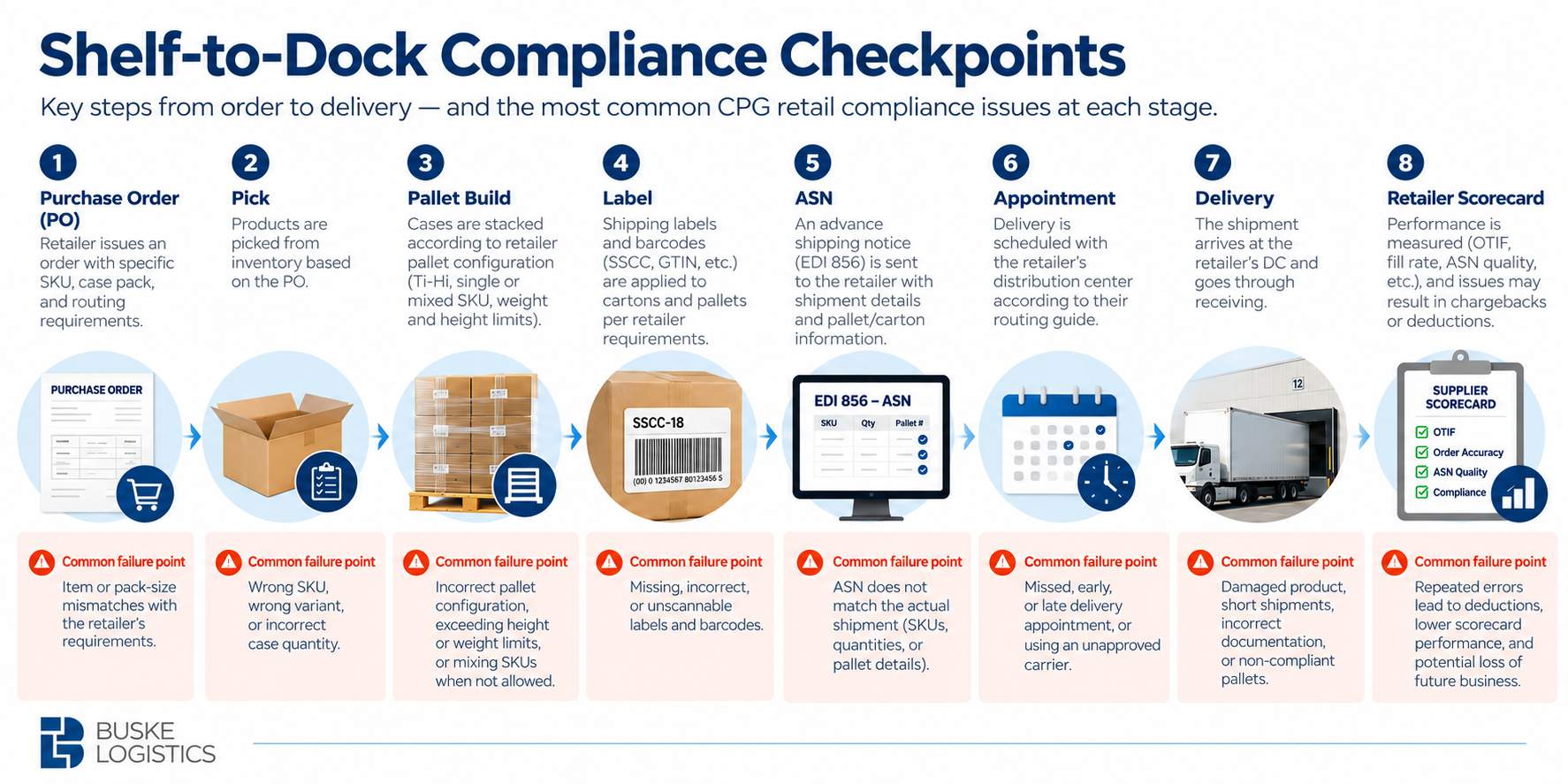
Compliance starts when products arrive at the warehouse.
A 3PL can verify incoming SKUs, case quantities, barcodes, and lot information against inventory records. For date-sensitive CPG products, appropriate lot tracking and first-expired, first-out (FEFO) processes can help prevent short-dated shipments.
When retail and DTC orders share inventory, a 3PL can establish allocation rules that protect committed replenishment orders.
This reduces the risk of short shipments when demand for fast-moving SKUs increases unexpectedly.
Before shipping, warehouse teams can verify that orders contain the correct products, case quantities, labels, and retailer-approved pallet configurations.
These checks also apply to promotional displays, mixed-SKU shipments, and seasonal CPG orders.
A 3PL with appropriate warehouse management and EDI capabilities can generate shipment data from verified packing activity.
This helps prevent discrepancies between physical pallets, shipping labels, ASNs, and retailer purchase orders. New retail accounts may also require EDI mapping, testing, and onboarding before shipments begin.
Retailer compliance continues after an order leaves the warehouse.
A 3PL can coordinate approved carriers, delivery appointments, and routing instructions while monitoring shipment performance. Reviewing retailer scorecards and chargeback reports also helps identify recurring issues and gather documentation for deduction disputes.
Before choosing a logistics partner, ask:
These questions help you evaluate whether a provider can support your specific retail accounts, rather than simply offering general warehousing services.
For additional evaluation criteria, see our broader CPG 3PL requirements checklist.
The takeaway: Effective CPG 3PL retail compliance depends on connected processes, accurate shipment data, and retailer-specific controls at every fulfillment stage.
Buske Logistics helps CPG brands manage retail compliance by combining warehousing, inventory management, retailer-specific fulfillment, and shipping coordination. With more than 100 years of logistics experience, Buske supports businesses navigating the operational demands of grocery, big-box, and other retail channels.
Rather than treating compliance as a final shipping check, Buske focuses on integrating retailer requirements into everyday warehouse processes.
Through its 3PL services for CPG companies, Buske supports fulfillment processes designed around retailer routing guides, labeling requirements, and shipping documentation.
These capabilities help CPG brands manage recurring replenishment orders while reducing preventable errors.
Buske's retail compliance services include EDI integration, labeling, and customized packaging support.
Connecting order information with warehouse fulfillment processes helps improve consistency between purchase orders, shipment contents, and the documentation retailers receive.
CPG brands frequently need more than standard case picking.
Buske supports retail-ready preparation, including kitting, labeling, and promotional packaging, helping brands prepare products for retailer-specific display and distribution requirements.
When your business serves both retail and ecommerce customers, coordinated inventory management helps reduce stock discrepancies and improve order accuracy.
Buske's broader logistics solutions for CPG brands are designed to support these fulfillment demands as your retail distribution needs evolve.
The goal is straightforward: Help your products reach retail distribution centers accurately, on schedule, and in accordance with each customer's shipping requirements, while reducing the operational issues that can lead to chargebacks.
Retail compliance for CPG brands means following retailer-specific requirements for shipping, labeling, pallet configurations, delivery appointments, ASNs, and order accuracy. These rules help retailers receive and process consumer packaged goods efficiently. Requirements vary across grocery, big-box, club, and other retail channels.
CPG brands receive retailer chargebacks when shipments violate a retailer's documented requirements. Common causes include incorrect barcodes, ASN mismatches, missed delivery appointments, short shipments, and improper pallet configurations. The specific violations and associated deductions depend on each retailer's policies.
A 3PL can reduce CPG chargebacks by checking orders, labels, pallets, and shipment data before dispatch. Retailer-specific fulfillment procedures, EDI integration, inventory allocation, and delivery coordination help prevent recurring errors that could otherwise result in deductions.
A retail routing guide is a set of shipping instructions that a retailer provides to its suppliers. It may specify approved carriers, freight terms, packaging requirements, delivery procedures, and appointment rules. CPG brands must follow the applicable guide when shipping replenishment or promotional orders.
An advance shipping notice (ASN) is an electronic document sent to a retailer before a shipment arrives. It identifies the expected products, quantities, and shipment details. For CPG brands shipping mixed-SKU pallets, ASN accuracy helps retailers verify incoming inventory against purchase orders.
Electronic Data Interchange (EDI) allows CPG suppliers and retailers to exchange purchase orders, ASNs, invoices, and other documents electronically. It reduces manual data entry and helps maintain consistent information across frequent replenishment orders, although transactions still require accurate underlying product and shipment data.
On-time, in-full (OTIF) measures whether suppliers deliver the required quantities within the retailer's specified delivery window. Poor OTIF performance can affect retailer scorecards and may result in deductions. Retailers use different measurement methods and performance targets.
No. CPG retail compliance focuses on retailer-imposed fulfillment requirements, such as shipping labels, pallet configurations, routing guides, and delivery accuracy. Regulatory compliance covers legal requirements, including applicable food safety, product labeling, and consumer protection rules. CPG brands may need to meet both.
Retail chargebacks often stem from preventable fulfillment errors, including inaccurate ASNs, incorrect pallet configurations, missed delivery appointments, and short shipments. For CPG brands managing frequent replenishment orders, addressing these issues before shipping can help protect margins and retailer relationships.
The right 3PL builds compliance checks into daily warehouse operations, helping you deliver products accurately and consistently across retail channels.
Explore Buske's 3PL solutions for CPG companies and our retail compliance services to see how we can support your fulfillment needs.
Still evaluating providers? Read our guide on how to choose a 3PL for your CPG brand.

Buske Logistics is a Top 20 Private Warehousing 3PL. Let's build a solution for your supply chain.


